Bail Is Not Freedom: Khurram Parvez and the Illusion of Justice in Kashmir
Altaf Hussain Wani
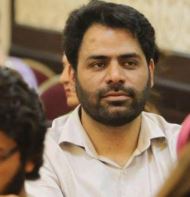
 When the Delhi High Court granted bail to Khurram Parvez this week, the news should have signalled the end of a nightmare. Instead, it offered a cruel reminder of how justice functions in Indian and particularly for the people of Indian occupied Kashmir.
The 49-year-old human rights defender, imprisoned for nearly five years, will remain behind bars. Despite securing bail in a November 2021 “terror funding” case brought by India’s National Investigation Agency (NIA), Parvez is still ensnared in a second, near-identical case lodged in March 2023. His lawyer, Swati Khanna, has expressed hope that a “positive result” in the remaining case could see him walk free within a month or two. But hope is a fragile thing when the state has perfected the art of perpetual imprisonment without conviction.
The choreography is now familiar to every political prisoner in India: when one case weakens, another materializes, ensuring that the prison gates never fully open. It is a technique of legal endurance, exhausting not the prosecution but the prosecuted, draining years from a life while judges parse technicalities with solemn detachment.


Parvez is not a militant. He is an internationally acclaimed rights defender, a recipient of prestigious human rights awards and young scholars’ honours who has spent decades documenting state violence in one of the world’s most militarized zones. As a leading voice with the Jammu and Kashmir Coalition of Civil Society (JKCCS), his painstaking documentation of enforced disappearances, extrajudicial killings, and systemic impunity provided the foundational evidence for the Office of the UN High Commissioner for Human Rights (OHCHR) reports on Jammu and Kashmir in 2018 and 2019.
He had mapped mass graves, traced the disappeared, and forced the world to confront what Delhi preferred to dismiss as internal disturbance. His archives were an act of fidelity to the dead and a warning to the powerful that memory could not be bombed into submission. His work gave international legitimacy to the suffering of Kashmiris. For this, he was punished.
The charges against him—terror funding, recruitment of rebels, and mobilizing protesters—were filed under the Unlawful Activities (Prevention) Act (UAPA), India’s principal counterterrorism law. The statistics alone expose the law’s true purpose. Nationally, the UAPA boasts a conviction rate of merely five percent. In Kashmir, that figure collapses to less than one percent.
These are not the numbers of a law used to prosecute genuine threats; they are the metrics of a tool designed to punish through procedure. Under Section 43D(5) of the UAPA, bail is effectively prohibited if the court perceives a prima facie case—a threshold so low that the prosecution’s narrative, however flimsy, becomes its own justification for indefinite caging.
The law presumes guilt and demands the accused prove innocence from inside a cell, a reversal of democratic justice that should horrify any constitutional order. Parvez has languished in jail for half a decade, yet trials have not commenced in either case. This is not an anomaly. It is the strategy. For political prisoners in India, the process itself becomes the punishment—a bureaucratic violence that consumes years of life without ever requiring the state to prove its allegations.
The global outcry against this persecution has been loud and consistent. UN special procedures, including the Special Rapporteur on the situation of human rights defenders, have repeatedly demanded Parvez’s immediate release, warning that his detention appears to be a direct reprisal for his legitimate advocacy. International rights organizations have uniformly condemned the charges as fabricated, arguing that Parvez’s real offence was not terrorism but testimony—bearing witness to abuses that powerful actors wished to keep in the shadows.
UN experts have stressed that the use of counterterrorism frameworks to criminalize human rights work violates international human rights law and the fundamental protections owed to defenders. The UN Working Group on Arbitrary Detention has previously concluded that such prolonged pre-trial detention without meaningful judicial oversight constitutes arbitrary detention under international law. Mary Lawlor, the Special Rapporteur on human rights defenders, has explicitly cited Parvez’s case as an example of the shrinking space for activists in IOJK, where anti-terror legislation is weaponized against those who speak for the voiceless. Their interventions highlight an uncomfortable reality: when documentation of abuse is rebranded as “terror funding,” the law ceases to be an instrument of justice and becomes an instrument of erasure.
Parvez’s imprisonment cannot be separated from the suffocation of Kashmiri civil society at large. The JKCCS office remains sealed, its silence a physical symbol of the space that has been forcibly emptied. A digital siege, layered atop decades of militarized repression, has systematically muted activists, journalists, and lawyers. The communications blackout of 2019, imposed when New Delhi unilaterally revoked the region’s limited autonomy, was not merely a severance of phone lines and internet cables; it was a severance of accountability itself. In that darkness, abuses flourished, and those like Parvez who sought to record them became primary targets. Parvez’s arrest proved to be “the last nail in the coffin of any meaningful rights activism in Kashmir.” In such an environment, a courtroom bail order is not a victory; it is a sleight of hand, distracting from the larger architecture of suppression.
The case of Khurram Parvez is therefore about far more than one man. It is about whether India can tolerate accountability in Kashmir. The grant of bail in one case while detention continues in another is not justice tempered with caution; it is administrative torture dressed in judicial robes. If the Indian state genuinely believes in the rule of law, it must release Parvez immediately, terminate these baseless proceedings, and unseal the spaces of civil society. The international community, too, must move beyond statements of concern to concrete pressure, recognizing that every day Parvez spends in jail is another day that human rights themselves are held captive. Sanctions on officials responsible for malicious prosecutions, scrutiny of trade partnerships, and consistent diplomatic pressure must replace the polite regret that has thus far characterized the global response. The credibility of international human rights mechanisms depends on their willingness to defend defenders when governments turn against them.
Freedom cannot be dispensed in instalments. Either justice is whole—or it is not justice at all.
The writer is Chairman of Kashmir Institute of International Relations (KIIR)
Can be reached at ; X @SULTAN1913