The Fingerprint Genocide: How India is Stealing Kashmiri Identity One Biometric at a Time
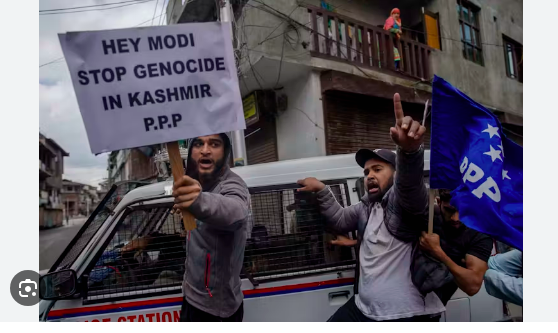 Muhammad Habib
The mention of the circular issued by the Indian government on 1st June, 2026, to “comprehensively re-verify  every citizen of Indian Illegally Occupied Jammu and Kashmir (IIOJK)” should have been taken for what it actually is: the most silent genocide ever “designed.The order demands all citizens to provide new iris scans, fingerprints and facial recognition data by September 1, 2026. The ones who fail will get their ration card frozen, bank accounts will be cancelled, they will not be enrolled in schools, and they will be deleted from the government’s database, all of which are bureaucratic euphemisms for administrative punishment.
The choreography is now a familiar one for all Kashmiri people of an occupation that is a policy that was announced, implemented and enforced without a debate, a review and by slowly strangulating the day to day survival of the Kashmiri people. As “national security” becomes the cover story, India is creatively disengaging the Kashmiri people from their identity, one scan at a time.
The people of IIOJK are NOT Criminals. They are weavers, shopkeepers, farmers who have assumed their authority and names by succumbing to the soil of Kashmiri lands. However, in the new system, a Kashmiri’s life is not certified through a birth certificate, but a server in New Delhi. In April 2026, a whistleblower in the Unique Identification Authority of India (UIDAI) leaked a chat that revealed that the biometric data of Kashmiri residents was passed on to the National Investigation Agency (NIA) without any warrants, which contradicts the provisions of the Aadhaar Act. For Kashmiri, it is not a service, it’s a cage
The figures reveal the reason for this lockdown. The Jammu and Kashmir Civil Liberties Union (JKCLU) reported that as of now, more than 340 thousand people have been “de-referenced” since 2019, with the majority being from families that have had a history of political dissent. In the absence of Aadhaar, a Kashmiri is not allowed to purchase subsidized food, avail health care services, open bank accounts or enroll in education. The poor little bastards are not the beneficiaries, the ghosts are instead the state which has shut down human rights offices, been responsible for the arrest of activists under the Unlawful Activities (Prevention) Act (UAPA), and blocked social media in the territory. These are the voices of the Kashmiri people that are being turned deaf to by the biometric bureaucracy.
The United Nations has stated that this digital discrimination is a threat. The UN Special Rapporteur on privacy in a report on India’s use of biometrics in conflict zones in July 2025 had expressed serious concerns about ‘function creep’ and ‘algorithmical blacklisting’ in India. Data could be used for surveillance and exclusion in a “high-risk environment,” such as IIOJK, the report said. Denial of subsidies linked to Aadhaar is an “economic strangulation” that can be cruel treatment under international law, according to the Working Group on Arbitrary Detention. However, Indian pays no heed to the worry of the UN, branding it as ‘interference in internal affairs’.
The biometric re-verification is part of the overall attacks on Kashmiri civil society. The same government that sealed the Jammu Kashmir Coalition of Civil Society (JKCCS) and jailed human rights activist Khurram Parvez for 5 years wants all the Kashmiri’s to undergo a digital test that can be cancelled anytime. The Public Safety Act (PSA) has already demonstrated that the state is able to detain without trial. The biometric regime demonstrates that it will starve indefinitely.If a fingerprint does not match, the state does not shoot a bullet when the Kashmiri’s ration card is frozen. It waits until it’s time for hunger to do the rest.
The legal system is shockingly efficient. As per Section 7 of the Aadhaar Act, authentication would be required to avail “subsidies, benefits and services” from the government. However, there is no judicial review for a “failed authentication. If the server refuses to accept the fingerprint – even if it’s not the right one or the fingerprints are marked as administrative – there’s no court that can force the food to be restored. In IIOJK where more than 70% of the people rely on subsidized rations, that power decides who eats and who does not.
There has been an inadequate international response. The Office of the UN High Commissioner for Human Rights (OHCHR) has kept a file on the use of biometric exclusion as a means of counterinsurgency.However, no sanctions have been suggested. The EU does not require any conditions to be met regarding the protection of biometric data in the context of trade negotiations. The United States is silent.Sanctioned statements are made, ration cards are frozen.
What is needed is a paradigm shift. Guns are still present. However, the latest one is the algorithm. India has found that it’s easier to remove a people from a database than to shoot its members in a street.Biometric blacklisting should be understood as collective punishment, which is banned by Article 33 of the Fourth Geneva Convention, and acknowledged by the world as such. Any country that respects digital rights should impose specific sanctions on the Indian officials that have implemented this regime.
This case is not a simple fingerprint case. It’s about if the world can withstand digital annihilation instead of physical occupation. It’s nearing September 1st. More than seven million Kashmiris are being asked to have their identity confirmed not on the basis of their land, their history, but by a computer server that can be turned off. India’s adherence to the rule of law depends on stopping the re-verification campaign, revoking de-referenced telephones and providing its database for international audit. Until then, another failed login, another frozen ration card, another hungry child is another finger on the trigger of a genocide where no one is left. Kashmiri people are bigger than biometrics. The occupation has been able to strip them down to just that, however.
The author holds a BS in Political Science and currently Researcher at Kashmir Institute of International Relations (KIIR) and can be reached at: [email protected]