Growing militancy punctures Modi regime’s electoral narrative of ‘peace, security, and development’ in India
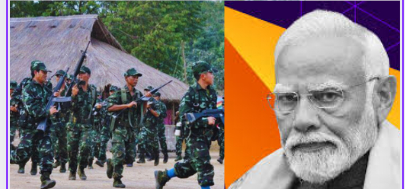 New Delhi: In what contradicts the Modi-led BJP regime’s central electoral narrative of “peace, security, and development, India is faced with return of growing militancy, where on Thursday Naga militants attacked an Assam Rifles Company Operating Base in Changlang, Arunachal Pradesh, injuring multiple soldiers.
According to Kashmir Media Service, the attack underscores the fragile security situation along the Assam–Nagaland–Arunachal corridor. Earlier, in September 2025, militants ambushed an Assam Rifles convoy in Bishnupur, Manipur, killing two personnel and injuring five. The People’s Liberation Army (PLA) claimed responsibility.
In Jul 2025, Assam Police arrested 22 cadres of ULFA-I and NSCN-KYA for militant recruitment and logistics in border districts. In October 2025, the Assam government extended AFSPA in Tinsukia, Charaideo, and Sivasagar districts for another six months, citing persistent militant threats and disturbed conditions.
The Naga insurgency began in the 1940s–50s, when Naga leaders demanded independence, leading to the formation of the Naga National Council (NNC) and later the NSCN factions. The NSCN (IM) has been in peace talks with New Delhi since 1997, but splinter factions like NSCN-KYA and ULFA-I continue their armed operations in the region.

Since August 2015, NSCN-KYA has been out of ceasefire with the Indian government and continues its activities across border areas of Arunachal Pradesh, Assam, and Nagaland. Between October 2024 and October 2025, over 10 encounters have taken place, killing over 35 Indian forces’ personnel and injuring over 60. It is clear that the group’s actions pose a serious threat to Indian endeavours in the Northeast.
Frequent Naga militant attacks, despite heavey Indian military presence and continued peace talks, have undermined New Delhi’s claims of full control or success in counter insurgency measures. The sustained operational capacity of NSCN, even after internal splits, highlights not only the fragility of the so-called peace process but also the growing vulnerability of India’s border security apparatus in the NortherEast.
Core issues like the demand for a “Greater Nagalim”, a separate flag, and constitutional recognition remain unresolved — fueling continued militancy and disillusionment. Repeated breakdowns of ceasefire agreements and slow progress in peace talks have eroded trust among local communities, who now view Delhi’s peace narrative as hollow.
Amid elections in Assam scheduled for March–April 2026, public frustration over unemployment, ethnic strife, and governance fatigue is growing. The renewed militant activity weakens BJP’s central electoral narrative of “peace, security, and development.”
These incidents are seen as evidence of mistrust toward BJP’s leadership and its inability to deliver lasting stability.
Opposition parties are likely to frame the unrest as a failure of BJP’s Northeast strategy, using the continuation of AFSPA and recurring violence to challenge its credibility.
In frontier districts, voters view each attack as proof that Delhi’s peace accords were politically motivated and not genuinely implemented — a potential blow to BJP’s traditional stronghold in upper Assam and border constituencies.
The Changlang attack and recent ambushes reveal that insurgency in the Northeast has entered a latent-reactivation phase — not full-scale war, but periodic violence to signal political dissatisfaction.
The timing before elections suggests militant groups are attempting to expose BJP’s governance weaknesses and highlight unfulfilled peace promises. If unrest continues, BJP may face a narrative backlash: that its “strong government” image has failed to ensure stability even after a decade in power.