Washington event urges global action to end India’s military occupation of Kashmir
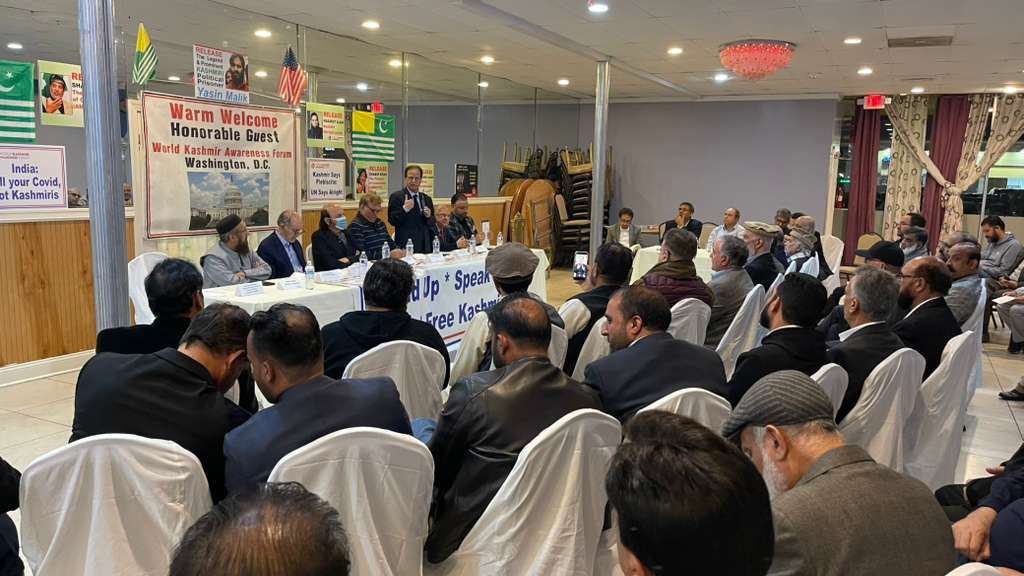
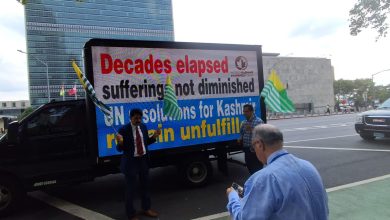
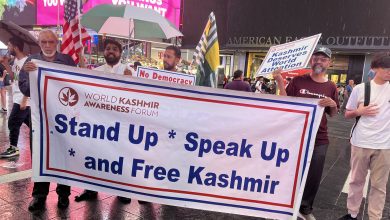
Washington, D.C.: A well-attended seminar titled “The Tragedy of October 27 When Kashmir Was Occupied” was organized by the World Kashmir Awareness Forum in Springfield, Virginia, to mark October 27 — the day in 1947 when Indian troops entered Jammu and Kashmir, occupying the territory.
According to Kashmir Media Service, speakers from diverse fields including academia, human rights, media, and the Kashmiri and Pakistani diaspora discussed the historical and political dimensions of the conflict, urging the international community to pursue a peaceful and just resolution of the Kashmir dispute.
The event began with the recitation of the Holy Quran by eight-year-old Anas Rahman and Naat-e-Rasul (SAWS) by journalist Javaid Kousar. Sardar Zarif Khan, Advisor to the President of Azad Jammu and Kashmir, welcomed the participants and explained the objective of the seminar—to raise awareness about the historical context of the Kashmir issue and promote dialogue among India, Pakistan, and Kashmiri leadership for peace.
Dr. Ghulam N. Mir, President of the World Kashmir Awareness Forum, termed October 27, 1947, as one of the most tragic days in the history of Jammu and Kashmir. He said that before the overt invasion, India carried out covert reconnaissance missions into Kashmir, followed by the genocidal operation known as the Jammu Genocide, in which over 237,000 Muslims were massacred in Jammu. More than half a million were forced to flee to Pakistan’s Punjab. He said, “This mass murder was executed by India’s Patiala Sikh regiment and RSS-backed militias, aided by Maharaja Hari Singh’s forces. Since then, Kashmiris have continued to resist occupation. We shall prevail, God willing.”
Mowahid Hussain Shah, member of the US Supreme Court Bar, in his keynote address said the main battle is fought in the mind, emphasizing the need to inject “passion, energy, and enthusiasm” into the Kashmir cause. He noted that India’s declining image in Washington has opened more space to advocate Kashmir’s case. “Civil society pressure toppled apartheid in South Africa and forced peace initiatives in the Middle East; Kashmir too needs fresh energy. It’s never too late to rejuvenate,” he stressed.
Dr. Zulfiqar Kazmi, Founder of Commongrounds USA, said, “We stand tonight in the Washington Metro area, just 13 miles from Capitol Hill, where democracy beats — and yet we speak for a people denied democracy for over seventy-seven years: the people of Jammu and Kashmir.” He added that justice delayed anywhere is a threat to peace everywhere. Referring to East Timor, South Africa, and Palestine, Dr. Kazmi questioned, “If the UN could act in those places, why not in Kashmir? Why must the valley of peace remain a valley of silence?”
Dr. Ghulam Nabi Fai, Chairman of the World Forum for Peace & Justice, urged the international community to intervene on humanitarian grounds to end the suffering of the innocent and unarmed Kashmiri population. He said that abuses in the occupied territory are pervasive, affecting every Kashmiri family, with the presence of Indian military personnel serving as a constant reminder of repression. Dr. Fai stressed that third-party mediation is essential for resolving the Kashmir dispute, noting that former US President Donald Trump had expressed readiness to mediate between India and Pakistan to avert a potential nuclear confrontation.
Dr. Imtiaz Khan, Kashmiri-American scholar, said that the credibility of the UN is at stake as India continues to disregard its resolutions and defy international law. He called upon the global community to impose sanctions and censure India for reneging on its commitments. “Anything less will allow this unresolved issue to snowball into a major regional or even global disaster,” he warned.
Dr. Zafar Iqbal Noori, Director of Masjid Al-Hussain, described the Kashmir dispute as a “festering wound on the body of the Muslim Ummah.” He said Kashmiris have proven their determination to resist India’s colonial occupation until they achieve their UN-guaranteed right to self-determination. He warned that India’s continued illegal occupation has already caused two wars with Pakistan and could trigger a catastrophic nuclear conflict in South Asia.
Sardar Shoaib Irshad, General Secretary of the Kashmir American Welfare Association (KAWA), in his concluding remarks, said that Kashmir faces an existential threat as India has issued over 4.7 million domicile certificates to non-locals in an attempt to change the region’s Muslim-majority demography. He said global powers’ inaction is the root cause of Kashmiri suffering and called for solidarity with the oppressed people of the territory.
A lively discussion followed between the speakers and journalists, including Zahid Hussain, Syed Adeeb, Ali Imran, Asfar Imam, Javaid Kousar, and Antique Sodozai, who shared valuable suggestions for amplifying the Kashmir cause internationally.
The seminar concluded with a Du’a led by Dr. Zafar Iqbal Noori.
Dr. Ghulam Nabi Fai, who also serves as the Secretary General of the World Kashmir Awareness Forum, thanked all participants for reaffirming their commitment to the Kashmiri people’s right to self-determination.