A Home Reduced to Rubble: The Unlawful Demolition of Dr. Umar’s Ancestral House & the Global Failure to Protect Justice
By Mushtaq Hussain
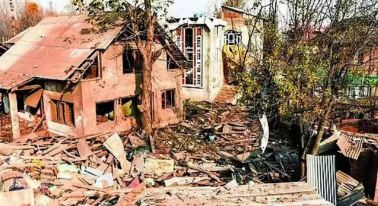
In Indian occupied Kashmir, the demolition of Dr. Umar Nabi’s ancestral home is not merely an administrative action—it is a direct affront to human conscience and international law. Intelligence agencies have alleged Dr. Umar was the suicide bomber in the Red Fort attack. Yet no formal charges were filed, no trial was conducted, and no verdict issued. Despite this judicial vacuum, a house with no proven connection to the alleged crime was destroyed using explosives. This is a blatant misuse of state power and a clear violation of international human rights law.
Legal and human principles are clear: Every individual is innocent until proven guilty in a court of law. Collective punishment, or imposing the consequences of one person’s alleged crime on family members, directly violates Fourth Geneva Convention, Article 33. Furthermore, ICCPR Article 17 prohibits arbitrary interference by the state in citizens’ homes or private lives. The destruction of private property is lawful only under military necessity (Fourth Geneva Convention, Article 53). Dr. Umar’s parents’ home was not part of any military operation, making this act a direct breach of international law.
Historical references illustrate that this is not an isolated incident. The Pahalgam incident shows that houses were demolished and young men killed in staged encounters based solely on suspicion. Political, religious, and civil society leaders raised serious questions, yet the international community remained largely passive, leaving affected families without justice. The same pattern is now evident in the demolition of Dr. Umar’s ancestral home.
The human and social consequences of such actions are profound. Collective punishment imposed on family members leads to psychological trauma, social isolation, and financial loss. Children, elders, and innocent civilians caught in retaliatory measures are victims of a gross violation of moral and ethical principles. International law clearly states that the punishment of one individual cannot be imposed on their relatives.
For the international community, this situation is a litmus test: will it stand up for human rights and legal principles, or remain silent? Immediate measures must include:
- Launching an independent international legal inquiry
- Deploying a UN Special Rapporteurs fact-finding mission
- Ensuring the affected family has access to the International Court of Justice (ICJ)
- Mobilizing global lawyers to provide pro bono legal assistance
This event violates not only legal standards but also fundamental human values and morality. Silence today risks the loss of justice tomorrow. Humanity demands that wrongdoing be exposed, the rule of law upheld, and affected families’ rights protected.