Shaikh Abdul Majid

A famous stanza by Urdu poet Rahat Indori rightly echoes today’s grim reality:
“Sarhaddon par bohat tanaav hai kya?
Kuch pata to karo chunaav hai kya?”


A week ago, the tensions were not crafted at the borders but in the capital Delhi for gaining the sympathy of voters in Bihar. Delhi was shaken by a car blast but its shockwaves weren’t contained there. They were quickly weaponised and tied to Kashmiris.
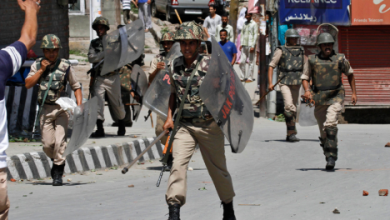
BJP’s victory in the Bihar elections has been celebrated by party leaders as a reaffirmation of their national mandate, yet the ripple effects of this political triumph have been felt far away from Bihar, sharply in Indian-occupied Jammu and Kashmir. While celebrations erupted in Patna and New Delhi, Kashmiris witnessed a familiar tightening of the Indian forces grid, creating an atmosphere of fear, suffocation and uncertainty.
Bihar’s win has been hailed as a major success but in Kashmir, the sentiment was somber. “BJP’s Bihar Win: Victory There – Violence Here and once again, Kashmiris paid the cost.” This feeling grew stronger as news of the Delhi blast circulated across India. While authorities in New Delhi scrambled to manage the crisis, Kashmiri families braced themselves for yet another cycle of suspicion, profiling, and collective punishment. History has taught them that any incident anywhere in India, regardless of location or context – rapidly transforms into raids, arrests, killings, and interrogations in Kashmir.
In the days following the Delhi blast, Indian agencies intensified operations, conducting night raids and detentions without any reason or proof. Entire neighborhoods were sealed, forcing residents, especially youth – to line up for inquiries that always lacked transparency. Several homes of those labeled “suspects” were blasted and demolished to garbage, leaving families homeless and terrified even before investigations had reached any conclusion. Such actions deepened the sense of chaos, reinforcing the belief that the lives and properties of Kashmiris can be upended at any moment under the shadow of suspicion.
The demolition of homes, seen by many as an act of collective punishment, added to the growing resentment. For the affected families, it was not just the loss of their shelter but the loss of their dignity, security, and stability. The message was clear: one accusation, proven or not – can erase a lifetime’s worth of hard work. Coupled with widespread raids and crackdowns, these demolitions turned the entire Kashmir into zones of fear.
As BJP leaders continued to celebrate their Bihar triumph, Kashmiris were subjected to a cycle of intensified surveillance and punitive action that felt less like security enforcement and more like political signaling. As BJP basks in its Bihar triumph, Kashmiris face fresh raids, detentions, and crackdowns. Their freedom remains the collateral of electoral politics. The timing of the Bihar election and the Delhi blast created a convergence that many Kashmiris viewed as disastrous for their safety. Every celebration in the corridors of power and every crisis elsewhere in India, seemed to translate into heightened repression in the Valley.
Political analysts and rights groups note that the disconnect between New Delhi and the Kashmiri population has grown even wider. Each political success outside Kashmir is accompanied by strict measures within, and each incident like the Delhi blast deepens the alienation. For the ordinary Kashmiri, the message is unmistakable: “when politics demands a show of strength, it is the people of Kashmir who become the demonstration ground.”
Finally, the celebrations in Bihar and the Delhi blast may appear related or unrelated on the surface, but for Kashmiris, they led to only one outcome: “more chaos, more crackdowns, more killings, more arrests, more demolished homes and further shrinkage of their space. While electoral victories are cheered elsewhere, the cost continues to be extracted from those who have already endured far too much for decades, with no end in sight.