Article 370 move was unconstitutional, against will of Kashmiris: Radha Kumar
Former interlocutor flags continuing rights violations, calls for broader dialogue on Kashmir
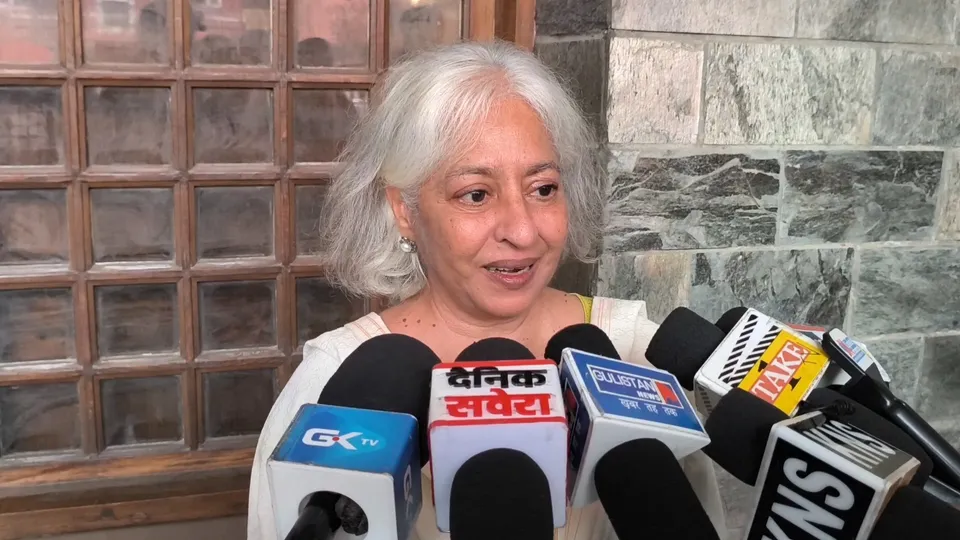
Srinagar, : Former Kashmir interlocutor and co-chair for the Forum for Human Rights in Indian illegally occupied Jammu and Kashmir (IIOJK), Radha Kumar, has said that the abrogation of Article 370 continues to evoke strong sentiment in the occupied territory, as it was carried out in an unconstitutional manner and against the will of the Kashmiri people.
According to Kashmir Media Service, Kumar made the remarks while speaking to reporters in Srinagar after meeting National Conference President Farooq Abdullah and party legislators. She presented the New Delhi-based Forum’s latest report on the human rights situation in the territory. She said the delegation also met CPI(M) leader Mohammad Yousuf Tarigami and discussed the findings of the report.
Kumar said, “We hope that some action can be taken at whatever level possible on the violations of human rights that are prevalent and ongoing”.

She said discussions with the NC leadership also covered the constitutional position of IIOJK and the broader issue of federalism in India. She maintained that the Jammu and Kashmir Reorganisation Act represented a major blow to India’s federal structure and called for political parties to unite to safeguard the constitutional rights of states.
Asked about the public response to the August 5, 2019 abrogation of Article 370, Kumar said the issue continues to evoke strong sentiment in IIOJK, adding the move remained a “very sore point” in IIOJK because it was carried out in a “clearly unconstitutional way”.
Recalling the events surrounding the August 5 actions, Kumar said that more than 5,000 political leaders and workers, including those from the mainstream (pro-India) parties, were detained and thousands of additional troops were deployed in the territory.
“It was clear that the Union [Indian] administration was aware that this was a very unpopular thing to do and they did it nevertheless against the will of the people. It is a violation both of Article 1 and 3 and the rights of states in the Constitution of India and a violation of the very first line of the Constitution” she added.
On India-Pakistan dialogue, Kumar said a lasting peace process required engagement on multiple fronts. “You needed a track of peace between the people, the elected representatives and the Government of India. You needed a track between the governments of India and Pakistan and you needed a track with the dissidents who are often called separatists,” Kumar added.