PwDs stage widespread protests across IIOJK, demand dignity, full rights
Disabled community denounces tokenism, calls Rs 1250 pension ‘an insult’
Srinagar: Widespread protests were held across Indian illegally occupied Jammu and Kashmir as Persons with Disabilities (PwDs) marked on Wednesday the International Day of Persons with Disabilities by demanding dignity, justice, and full implementation of the Rights of Persons with Disabilities (RPwD) Act 2016.
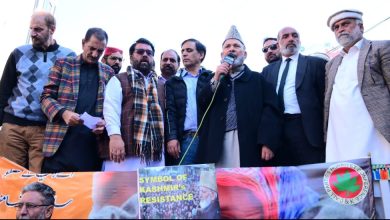
According to Kashmir Media Service, hundreds of PwDs from different districts assembled in Srinagar under the banner of the J&K Handicapped Association, asserting that their legally guaranteed rights remain out of reach. The protesters said the RPwD Act—implemented across India—continues to remain “on paper only” in IIOJK, despite being formally adopted in 2018.
J&K Handicapped Association President Abdul Rashid Butt said the delay in implementing the law amounted to a denial of basic rights, including social welfare, employment, accessibility, and protection from discrimination. “Every state in India has implemented the Act. Only [occupied] Jammu and Kashmir remains excluded. Our rights are being withheld deliberately,” he said.
He added that while the earlier 1995 law recognised only seven disability categories, the 2016 Act expanded them to 21—bringing the PwD population in the territory to nearly 10 lakh by the association’s estimates.
Butt criticised the current horizontal reservation for PwDs, calling it ineffective. “Posts get merged or lost during recruitment. If reservations were vertical, like SCs, STs, and OBCs, vacancies would accumulate and guarantee representation. Today thousands of disabled youth sit jobless,” he said.
He also condemned the meagre pension of Rs 1250 per month, calling it “an insult” amid rising inflation. “What can a disabled person do with Rs 1250 today? We demand at least Rs 5000 to survive with dignity,” he said.
Senior association member Wasim Feroze Mattoo said the Act promises accessible buildings, education support, social security, and penalties for discrimination—yet none of these are implemented. “We face challenges everywhere—schools, offices, hospitals, public spaces. Even welfare offices lack ramps and accessible toilets. We are lifted on shoulders to enter buildings; it is humiliating,” he said.
The protesters said that while officials organise events and photo sessions on December 3, “no one remembers PwDs after the day passes.”
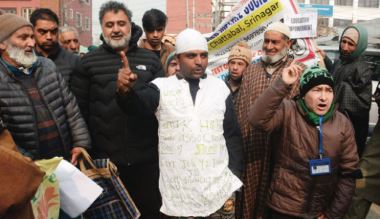
In Baramulla, dozens of PwDs staged a demonstration at Karyappa Park, accusing successive regimes of abandoning the disabled community.
President of the J&K Ittihad Handicapped Welfare Association, Farooq Ahmad, said their suffering had become “unimaginable” as they struggle to survive on the current pension. He said the government’s rule of increasing the pension to Rs 2000 only after a person turns 80 was unrealistic. “Most disabled persons do not even reach that age due to health complications,” he said.
Ahmad said that despite the RPwD Act promising enhanced benefits and protection, authorities have failed to take any steps toward its implementation. He urged the administration to revise the Act’s enforcement mechanisms and ensure the disabled community lives with dignity.
“When electricity bills alone exceed Rs 1500, how is a person expected to run a home on Rs 1250? We appeal for justice, equality, and respect,” he said.
The protests across IIOJK highlighted systemic neglect, exclusion, and administrative apathy toward the disabled community living under occupation. The protesters vowed to continue their struggle until all provisions of the RPwD Act are enforced in letter and spirit.