Indian forces brand local youth as ‘foreign militants’ in poster drive
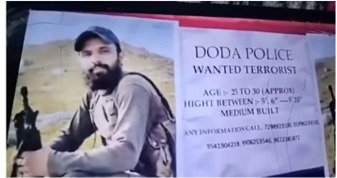
Srinagar: Indian army and police have launched what observers describe as a calculated campaign in Indian illegally occupied Jammu and Kashmir by branding local Kashmiri youth as “foreign militants” and pasting their posters in public places in an attempt to distort the indigenous character of the Kashmir freedom movement.
According to Kashmir Media Service, as part of the ongoing poster campaign, forces have intensified operations in the Doda and Kishtwar districts of the Jammu region in February 2026, releasing posters of several local resistance youth leaders across the Chenab Valley. Among those named are Saifullah and Mohammad Amin alias Jehangir Saroori. Police describe Saroori as the longest-surviving Hizbul Mujahideen commander in the region and allege he is hiding in the higher reaches of Kishtwar or Doda
Police in Doda district have pasted posters at several strategic locations seeking information about an alleged “Pakistani commander” Saifullah. Senior Superintendent of Police, Doda, Sandeep Mehta, claimed that Saifullah is believed to be hiding in the Chatroo belt of adjoining Kishtwar district and may attempt to escape in disguise.


Officials said posters carrying photographs — both with and without a beard — have been displayed at key checkpoints and public places, including Nagri, Dessa, Ganpat Bridge at the Doda entry point and Thathri. Police have urged the public to share information and to inform authorities before renting out houses or shops, stressing prior verification in the name of security.
However, political observers and members of civil society in the occupied territory say that such poster campaigns form part of a broader strategy to portray the Kashmir freedom movement as being sponsored from across the Line of Control, rather than acknowledging it as an indigenous struggle for the right to self-determination. They contend that repeatedly labeling local youth as “foreign militants” is aimed at misleading the international community and diluting the political nature of the Kashmir dispute.
Analysts further argue that the campaign provides a pretext for prolonged cordon-and-search operations, raids and crackdowns in the Doda–Kishtwar belt and other parts of the Jammu region. They say that under the guise of hunting “foreign militants,” Indian forces intensify surveillance, conduct house-to-house searches, detain youth for questioning and create an atmosphere of fear among residents.
The analysts added that the Indian Army’s actions in Kashmir have been perpetuating a culture of oppression and humiliation, with reports of human rights abuses and excessive force being used against civilians. The deployment of troops and imposition of restrictions have severely impacted daily life, sparking widespread resentment and anger among Kashmiris, who feel their land is being occupied and their rights are being trampled.
Meanwhile, officials stated that search operations have been continuing in the Thathri and Gandoh areas of Doda, and that a hideout was busted in Chilli forest. Massive combing operations are also underway in the higher reaches of Doda, Kishtwar, Kathua, Udhampur, Rajouri and Poonch districts following recent encounters.
Critics maintain that the branding of local youth as foreign militants is being used not only to justify the militarisation of civilian areas but also to undermine the legitimacy of Kashmiris’ political aspirations. They warn that such measures risk further alienating the local population and deepening mistrust, rather than addressing the root causes of the longstanding dispute.