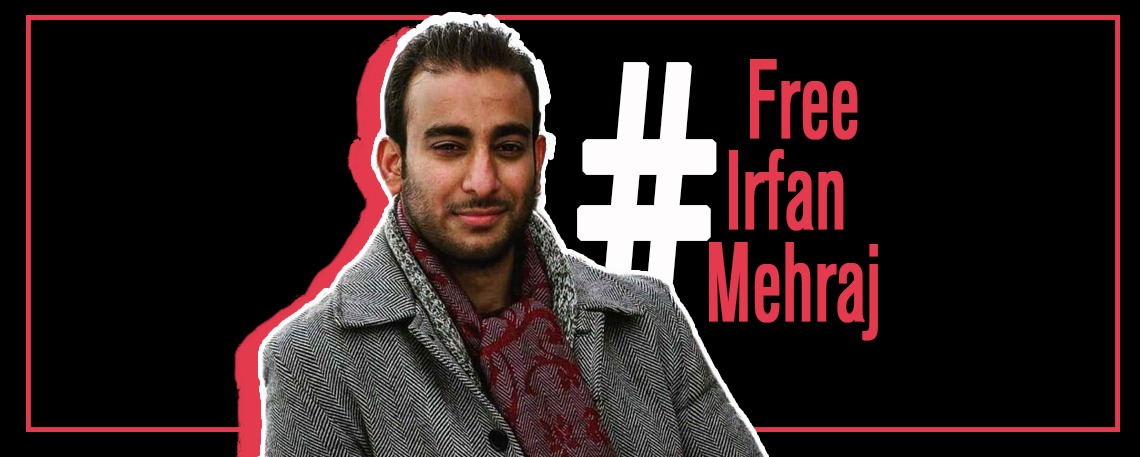
Kashmiri journalist Irfan Mehraj has spent more than 1,100 days in pretrial detention in a Delhi prison, arrested under India’s anti-terror law–UAPA– allegedly for work he did years earlier at a human rights organisation. While the courts deliberate, his wife, his ailing father, and his grieving mother keep vigil across 800 kilometres, waiting for a man the law has not yet tried.
Bisma was still adrift in the early warmth of a marriage only a few months old when, on 20 March 2023, a quick phone call tore apart the soft glow of her emotions. Her brother-in-law had called with the worst possible news: Officers from the National Investigation Agency (NIA), one of India’s federal investigating agencies, had arrested her husband, Irfan Mehraj.
Irfan, an award-winning journalist, was taken into custody at Ram Munshi Bagh police station in Kashmir’s capital Srinagar under the controversial Unlawful Activities Prevention Act (UAPA). After being held overnight at the station, he was transferred to Delhi — some 800 kilometres from his home — and presented before a court before being jailed.
Three years on, Irfan languishes in a prison in New Delhi while Bisma and his family members reminisce about what they call “the dark day” of their lives back home in Kashmir. Spring, otherwise a harbinger of hope, has lost its meaning for them, turning ominous instead.
And this summer, Bisma is preparing for yet another Eid-ul-Azha–the festival that marks the culmination of the annual Hajj pilgrimage–without Irfan. She tries to uphold tradition: she buys groceries, new clothes, and prepares meals.
“Irfan is a hopeful person, and I try to live up to his expectations. I chose the colors of his choice,” says Bisma, who married Irfan in September 2022, just six months before his arrest separated them.
“Now I have become a different person with my exposure to a surreal situation,” Bisma says. It seems his incarceration has become hers as well.
Irfan’s pretrial detention has stretched well beyond what any family should have to endure. Life for them has been reduced to parsing stacks of legal documents dense with complicated legalese, grappling with serious charges, and hoping for bail at every court hearing over the past three years.
WHO IS IRFAN MEHRAJ
Born in 1990 at the height of the militancy in Kashmir, he studied at Caset Experimental School in Srinagar before completing a bachelor’s degree in arts from Amar Singh College. Later, he earned a postgraduate degree in mass communication and journalism in 2015 from Kashmir University in 2015, after which he wrote for local, Indian, and international platforms.
Irfan wrote about a wide range of issues: human rights, drug abuse, the environment, and the political situation in the region. He edited stories for the website TwoCircles.net and founded his own publication, Wande Magazine, which published long-form journalism on culture, politics, and literature. He won an international award for his reportage on drug abuse in Kashmir, which appeared in Germany’s Deutsche Welle (DW), the outlet he was working for when he was arrested.
In a decade-long journalism career, it was his early, brief association with the Jammu and Kashmir Coalition of Civil Societies (JKCCS) as an intern and researcher that would return to haunt him years later. His 2023 detention is allegedly linked to that past association, with the NIA levelling accusations of “terrorism and secessionism” against him in connection with the “NGO terror funding case” launched against JKCCS and other NGOs in Kashmir in 2020.
The case has been registered under Sections 120B and 124A of the Indian Penal Code (1860) and Sections 17, 18, 22A, 22C, 38, 39, and 40 of the Unlawful Activities Prevention Act, 1967.
“I know he is innocent,” says Bisma. “I believe he will return home soon.”
CALLS FROM JAIL AND SOLITUDE
Since the arrest, anxiety has settled into the months and years for Bisma and the rest of the family. Their days are weighted down by the uncertainty they push to the shadows of their daily routine.
From jail, Irfan is permitted by procedure to make two calls home every week to a pre-registered mobile number. One is a video call of around fifteen minutes; the other, an audio call of about five minutes.
“Our marriage and pledges of spending life together have reduced to these two calls, which many times are shared by other family members as well,” says Bisma.
The challenges of surviving and sustaining a relationship under so many constraints can be overwhelming. Irfan often reiterates his innocence and urges the family not to break down.
“We talk about our families, each other’s health, the new books and clothes he may need inside the prison,” says Bisma. “He is always reassuring and insists that I take care of myself.”Bisma teaches at a private school, her days moving between the classroom and lesson plans. “Trauma either breaks you, or it teaches you how to survive,” she says.
For Irfan’s family, the prison is now woven into the larger fabric of family life. They pray every day for Irfan’s release and for others languishing in the same jail. From brief conversations during jail visits and on the phone, they have grown intimate with the rhythms of the prison system.
THE COST
Irfan’s father, Mehraj Din Bhat, suffers from chronic kidney disease, diabetes, and heart problems. He remembers the last time he held his son — a hug at Ram Munshi Bagh police station, the day Irfan was detained.
Two years passed before he could travel to Delhi in January 2025 to meet him again. The costs of incarceration: legal fees, travel for jail visits, time lost, push families into financial and psychological crisis. These burdens, he says, are rarely acknowledged by the judicial system.
“I am aware of his innocence from the very moment they took him into custody,” says Bhat.
He has been trying to revive the family’s traditional Kashmiri handicraft business, for which he travelled across India and spent stretches of time in Kolkata. He had almost retired because of his ailments. But he has taken it up again, to stay occupied and keep the household running. He has now limited it to his clientele and visitors in Kashmir.
“He was a brilliant student, a calm kid and very shy,” says Mehraj Din.
Mehraj says it was at Irfan’s insistence that he returned to the Valley from Kolkata after his kidney problem diagnosis. He had worked for nearly two decades outside Kashmir, selling handicrafts across the country. “Now, when I am back, he is away,” he says.
Haneefa Akhtar, Irfan’s mother, traces the contours of her son’s face in a photograph published in The Washington Post, kisses it, and weeps. “I am sure he will survive through this; he is a fighter.”
A 21 June 2023 edition of The Washington Post carried pictures and a full-page solidarity statement in support of Irfan and other jailed journalists in India. The statement was issued jointly by organisations including the Committee to Protect Journalists, the International Press Institute, the National Press Club, Reporters Without Borders, the International Women’s Media Foundation, the James W. Foley Legacy Foundation, the Reporters Committee, and the World Association of News Publishers.
The solidarity statement was published ahead of the Indian Prime Minister’s scheduled visit to the White House.
“India is one of the world’s largest democracies, yet it is one of the world’s most dangerous countries for the media… we stand in solidarity with the courageous journalists in India who are detained for reporting news,” read the solidarity statement.
The longing for her son’s return, compounded by the precariousness of home life, has pushed Haneefa into a cycle of illnesses, many of them unexplained.
“It feels like I have a huge rock on my chest that keeps choking me.”
Resilience, learnt the hard way over years of life in a politically volatile region, holds the household together, and yet she often experiences a crushing weight in her head and chest.
“He showed me his bylines whenever a story was published. Now, unfortunately, his life has become a story.”
Irfan’s younger brother, Faizan Bhat, has been thrust overnight from consultant to decision-making elder of the household. He now holds the family together and tries to keep calm. He follows the case diligently and shuttles between Srinagar and New Delhi to attend court hearings and visit his brother.
In the early days after Irfan’s arrest, when investigators moved him to the NIA headquarters in Delhi, Faizan had to wait through several days of uncertainty before he could see his brother when Irfan was transferred to Rohini Jail, part of the Tihar prison complex.
Faizan remembers waiting for the NIA to file its chargesheet, and then the bail hearings that kept getting delayed. The hardest part, he says, has been watching the case stretch across hearing after hearing while the family waits for answers.
“I only want my brother to come home. Everything else can come later.”
LEGAL BATTLE
Lawyers point out that such cases involve lengthy arguments and complex procedures. India’s Supreme Court recently observed, in CBI vs Dayamoy Mahato, that UAPA cases pending for over five years should be heard on a regular basis, and requested high courts to examine the backlog in their states.
Advocate Rajat, Irfan’s lawyer, presented his arguments in multiple hearings this year, with the latest on May 18, 2026. The transfer of judges at critical junctures has lengthened the timeline.
“Arguments reached the final stage more than once, and the judge changed at that point. Each transfer requires the new judge to review documents and understand the entire case again.”
The family also faces the practical burden of accommodation and travel costs as the case is heard in Delhi. The toll on the family’s finances and well-being is considerable. One Delhi lawyer who has followed the proceedings says the system places “heavy pressure” on families who live far away.
“Cases connected with national security laws often move to Delhi even when the events took place elsewhere.”
The Government of India has announced plans to open additional courts to handle serious cases, including UAPA, in the coming months. Lawyers hope the new courts will accelerate the process once they begin operating.
SOLIDARITY AND SUPPORT
Irfan’s friends and the journalist fraternity in India and around the world have repeatedly demanded his immediate release and the dropping of all charges.
“The prolonged detention of Irfan Mehraj, without bail, is despairing and flies in the face of all processes of natural justice. It also marks the silencing of an important voice on Kashmir,” says Geeta Seesu, founder of Free Speech Collective.
She further adds, “There is total opacity in the legal process for Mehraj and little or no evidence against him… Since when did researching and reporting on human rights abuses, on the plight of ordinary people in a highly militarized zone, and documenting the families of the disappeared become terrorist activity? Voices that question and dissent are crucial for society, and keeping them in jail without any bail or even a trial is antithetical to democracy.”
The Press Club of India, the Editors Guild of India (EGI), and the Journalist Federation of Kashmir (JFK) have also issued repeated statements demanding his release.
“EGI is deeply concerned about the excessive use of UAPA against journalists, most recently in the case of Irfan Mehraj. The Guild urges the state administration to respect democratic values.”
In a recent statement marking Irfan’s 1,000th day in jail, JFK said the situation was “not just a personal and professional tragedy for Irfan and his family but also reflects the larger state of press freedom and civil liberties in Jammu and Kashmir.”
In a joint statement, Human Rights Foundation (HRF) and Forum Asia wrote that Mehraj’s case “exemplifies India’s practice of ‘trial by jail.’” Hannah Van Dijcke, legal and research officer at HRF, wrote, “Dissidents are subjected to indefinite pretrial detention, whereby the legal process itself becomes the punishment.”
In 2025, the United Nations Human Rights Council found that Irfan’s “detention not only contravenes international legal standards — including provisions of the ICCPR and the UN Declaration on Human Rights Defenders — but also exemplifies the misuse of counter-terrorism laws like UAPA to target individuals engaged in lawful advocacy and journalism.”
UAPA IN INDIA
A 2022 Lok Sabha bill presented by the Congress Lok Sabha member Shashi Tharoor, on the repeal of UA(P)A, described the law as having “opened the door to a gross abuse of power” in contravention of Article 21 of the Constitution and international counter-terrorism standards. It further stated that this act also allows for searches, seizures, and arrests based on the “personal knowledge” of police officers, “without written validation from a superior judicial authority.”
Under the 2019 amendment to the UAPA, the state gained the power to designate individuals as “terrorists”, a power previously restricted to naming groups as “terrorist organisations”.
A report by People’s Union for Civil Liberties found that 97.2 per cent of the 8,371 people arrested under UAPA between 2015 and 2020 were ultimately acquitted.
Lok Sabha data from 2025 showed that 10,440 people were arrested across India between 2019 and 2023 under UAPA. Jammu and Kashmir recorded the highest number of arrests — 3,662 — in the country during that period.
According to Free Speech Collective’s 2024 report, in the first two years after the abrogation of Article 370, more than 40 journalists in Kashmir had been called for questioning, summoned, or had their premises raided.
THE WAIT CONTINUES
Back home in Kashmir, Bisma, Irfan’s family, and the journalist fraternity remain anxious, but hopeful of his eventual release.
“He is an intelligent, jolly person, who we hope would soon be among us, cracking a joke over a cup of tea,” says Sajad, a childhood friend from the neighbourhood.
With yet another Eid passing without Irfan, Bisma says it has been three years of solitude.
“I keep thinking the next Eid will be different. I imagine he will walk in, sit here with his books, and life will finally begin again.”
Safeena is a journalist based in Indian occupied Jammu and Kashmir
Source: The Contrapuntal