Rights groups condemn Indian govt for blocking Cockroach Janata Party X account
Viral youth-driven satire movement emerged after CJI’s “cockroaches” remark about unemployed youth
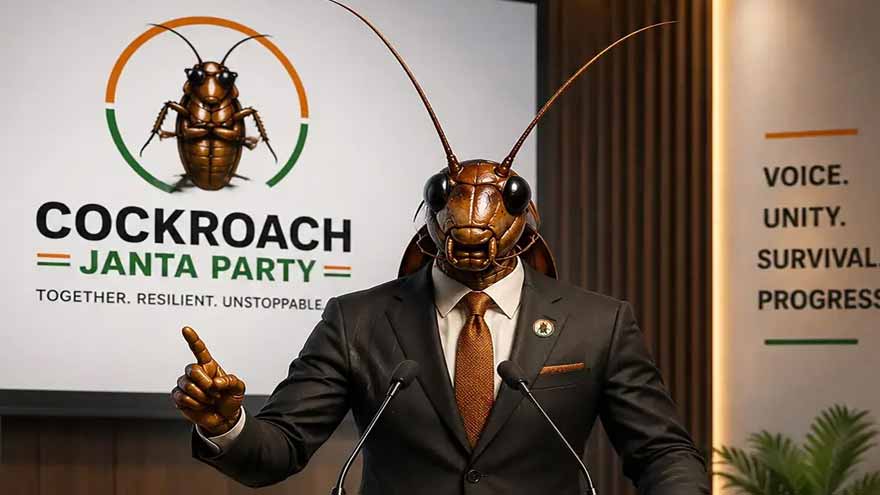
New Delhi: Rights groups, including Amnesty International India, have strongly condemned the BJP-led Indian government’s decision to block the X account of the Cockroach Janta Party operating under the handle @CJP_2029, a parody account that had been gaining significant traction among young people.
According to Kashmir Media Service, the Cockroach Janata Party, also known online as the “Cockroach Party of India,” is a viral social and political youth-driven online movement that emerged in response to a remark by India’s chief justice, who referred to unemployed youth as “cockroaches.” In protest, young users launched a satirical online campaign to voice their anger and frustration, highlighting issues such as unemployment, exam paper leaks, corruption, inflation, political discontent and worsening economic conditions faced by Indian youth. The movement has attracted support from students, young professionals, and some political figures. While not yet a formally registered political party, it has sparked a broader public debate in India on youth unemployment, governance and state accountability. Known for slogans like “Rise, Resist, Reclaim,” the page gained attention for its satirical and anti-establishment digital campaign style.
The account @CJP_2029 was withheld on May 21, 2026. The Indian Express reported that the blocking directions followed inputs from the Intelligence Bureau citing threats to India’s sovereignty and national security — as well as the fact that the account was “gaining traction among young people.”

In a statement, the International Freedom Foundation (IFF) called the move a “blatant misuse of State power” and an “arbitrary and disproportionate attempt to stifle freedom of speech and expression”. It said political commentary and criticism of public institutions are protected forms of speech under the Indian Constitution, adding, “The popularity of the account or the fact that the account mobilised young people through political expression cannot by itself be treated as a threat to national security.”
Amnesty International India also expressed concern, calling the action “another example of the shrinking space for dissent.” It noted that the government is simultaneously pushing amendments to digital rules that that could further expand state powers over online content.
“The withholding of the CJP account shows how quickly political humour becomes a target once it reaches a mass audience,” Amnesty said, adding, that a parody account should not become another example of online censorship in India.