Syed Ali Geelani: A Lifetime of Unyielding Conviction, Resistance and No Surrender
A steadfast voice for Kashmir’s right to self-determination and an unwavering advocate of its accession to Pakistan
Mushtaq Hussain
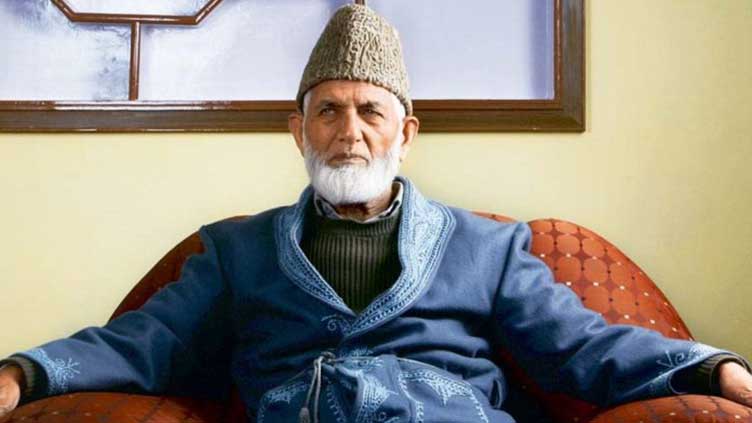
Syed Ali Shah Geelani occupies a distinctive place in the modern political history of Jammu and Kashmir. For decades, he remained one of the most uncompromising voices opposing Indian rule in the region, devoting his life to the legitimate struggle of the Kashmiri people for freedom, dignity and self-determination, and to the implementation of the United Nations resolutions on Jammu and Kashmir. His political journey was defined by extraordinary personal sacrifice, imprisonment, restrictions and relentless pressure. Yet none of these hardships succeeded in persuading him to abandon the principles to which he had devoted his life.
For Geelani, the Kashmir question was never simply a dispute over territory or administrative control. He consistently presented it as a question of the political rights, identity, dignity and aspirations of the people of Jammu and Kashmir. He believed that a durable solution could emerge only through respect for the wishes of the Kashmiri people and the fulfillment of their right to determine their own political future.
A Voice That Spoke Directly to Power
Geelani’s political courage was reflected in his decision to address the Indian Parliament directly. Rather than limiting his message to political gatherings or public statements, he took his case to the very institution representing the state whose policies he opposed.
Writing on behalf of the people he represented, he stated: “I am addressing you on behalf of my people, who have been striving for peace, justice, freedom and dignity.”
Those words captured the essence of his political philosophy. For Geelani, peace could not simply mean the absence of open conflict. Genuine peace, in his view, had to be accompanied by justice, freedom and dignity.
He went on to describe what he regarded as the consequences of decades of Indian military presence and state policy: “During these years we have suffered immensely at the hands of your armed forces, who are implementing the policy of subjugation and control over our lives, resources, culture and dignity.”
For Geelani, military power could suppress dissent, restrict political activity and silence individuals, but it could not permanently extinguish the political aspirations of a people.
Force could impose silence, but it could not resolve the political question at the heart of the Kashmir dispute.
A Foresight That Time Would Vindicate
Another defining feature of Geelani’s political legacy was his foresight. Long before India’s August 5, 2019, actions and the measures that followed, he repeatedly warned that unilateral changes could undermine Kashmir’s political and historical identity and pave the way for far-reaching demographic and political transformation.
He had warned of an attempt to weaken Kashmir’s distinct identity, transform its demographic character, reduce its Muslim majority to a minority and ultimately reshape the territory in accordance with a political vision he regarded exclusionary. Developments following August 5, 2019, gave renewed significance to those warnings.
His foresight therefore deserves not only recognition but serious consideration by the international community. The continued silence of major powers has not resolved the Kashmir dispute; instead, it has allowed an already protracted conflict to become even more deeply entrenched. For the people of Kashmir, such silence represents a continuing failure of international responsibility to address the political dimension of the dispute.
Geelani’s warnings are not merely part of political memory. His speeches, statements and writings remain widely available through public archives and social media, providing a substantial documentary record of his concerns, arguments and predictions.
No Compromise on Principle
The defining feature of Geelani’s political life was consistency. Governments changed, political circumstances shifted and the regional landscape underwent profound transformations, but his fundamental position remained remarkably constant.
He refused to endorse political compromises that he believed fell short of the aspirations of the Kashmiri people. His approach was not shaped by the pursuit of office, personal privilege or political accommodation. Instead, he demonstrated a willingness to endure personal hardship rather than retreat from his convictions.
Arrests, detention, political restrictions, surveillance and prolonged confinement became recurring features of his life. In his later years, his physical movement was severely restricted, yet his political voice remained unmistakably defiant.
His life became a powerful illustration of a simple principle: a person may be physically confined, but conviction cannot be imprisoned.
His Unwavering Bond with Pakistan
Geelani also consistently emphasized Pakistan’s political, moral and diplomatic role in supporting the Kashmir cause. In his communication to the Parliament of Pakistan, he expressed gratitude for the solidarity of the Pakistani people and called for continued support from Pakistan’s political leadership and wider society:
“We are grateful for the support of the Pakistani people and expect that politicians and all sections of Pakistani society will continue to extend its moral, political and diplomatic support to the Jammu and Kashmir freedom struggle.”
The message reflected his belief that the Kashmir issue required sustained political and diplomatic engagement rather than occasional expressions of solidarity. He expected Pakistan to continue raising the issue internationally and advocating for the political aspirations of the Kashmiri people.
His famous declaration, “Hum Pakistani hain, Pakistan hamara hai”—“We are Pakistanis, Pakistan is ours”—became inseparable from his political identity and vision for Kashmir. The slogan reflected his deeply held belief that the future of Kashmir was intrinsically linked to Pakistan and that the wishes of the Kashmiri people must remain central to any settlement of the dispute.
For Geelani, support for Pakistan was not merely a political slogan; it was a central element of his lifelong political conviction. He repeatedly called upon Pakistan to remain steadfast in its diplomatic, political and moral support for the Kashmiri people and to continue advocating their right to self-determination.
His lifelong advocacy for Kashmir’s accession to Pakistan remained one of the defining features of his political career. This position represented not merely a political preference but a deeply held conviction about the political future of Kashmir. Even amid prolonged imprisonment, house arrest and political restrictions, he did not retreat from this position. His commitment to the cause remained firm until his final days.
No Surrender—Until the End
Syed Ali Shah Geelani died on September 1, 2021. He did not live to see the political outcome for which he had spent his life advocating, but he remained committed to his fundamental position until the end.
To his supporters, Geelani represented steadfastness without surrender, conviction without compromise and leadership without fear. His significance lies not merely in the positions he adopted, but in the extraordinary consistency with which he defended them despite the personal consequences.
His life demonstrated that political convictions are ultimately tested not when they are convenient, but when maintaining them carries a heavy personal cost.
Syed Ali Geelani chose principle over convenience, conviction over compromise and steadfastness over surrender. His voice fell silent, but the questions he spent a lifetime raising did not. Until his final breath, he remained committed to the cause of Kashmir and to the political rights and aspirations of its people. His legacy endures as a powerful testament to unwavering conviction, sacrifice and resistance.