‘1947 Jammu massacre darkest chapter of Kashmir’s history’: Report
Islamabad: Tens of thousands of Muslims were massacred by Indian army, Dogar and Hindutva forces in November 1947 when they were migrating to Pakistan from Jammu, Indian illegally occupied Jammu and Kashmir.
An analytical report released by Kashmir Media Service, today, said that Kashmiris on both sides of the Line of Control (LoC) and the world over observe Jammu Martyrs’ Day on November 06 every year to remember sacrifices of the Jammu Muslims.
The report said the massacre of Jammu Muslim in 1947 was the worst massacre of human history and the killing of Kashmiris that started in 1947 still continued.
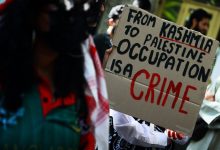

It said Jammu massacre of 1947 is the darkest chapter of Kashmir’s history as scars of the gruesome massacre of Jammu Muslims are still fresh in Kashmiris’ memory. The massacre of Jammu Muslims was meant to change the demography of the territory and the carnage is a reminder of the criminal face of Hindutva forces, it added.
On August 10, 1948, The Times of London, in a report titled “Elimination of Muslims from Jammu”, said, out of a total population of 411,000 Muslims in the districts of Jammu, Udhampur, Kathua and eastern part of Reasi, “237,000 Muslims were systematically exterminated”, “ by all the forces of the Dogra state, headed by the Maharaja in person….” According to this report, two-thirds of the region’s Muslim population was eliminated, altering the demographic composition of the area.
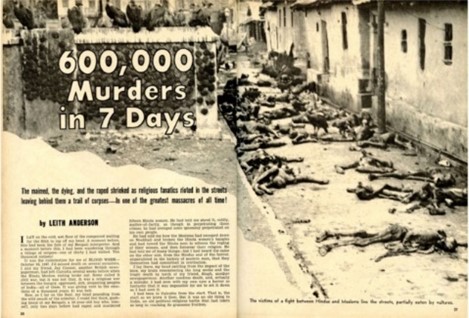
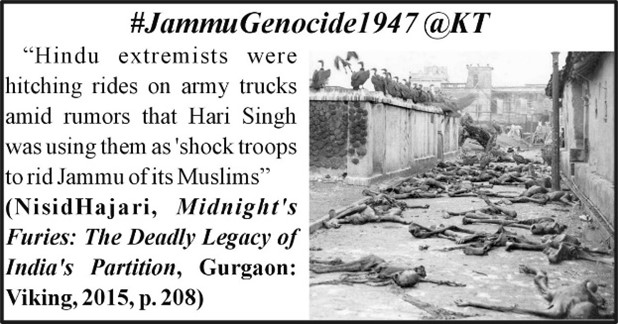
A report published in The Times (London) on August 10, 1948, which was written by a special correspondent (later identified as Frederick Paul Mainprice,) said that 237,000 Muslims were systematically exterminated killed in the Jammu region between October and November 1947 by the forces of the Dogra State, headed by Maharaja Hari Singh, and aided by extremist Hindus.
The most detailed account of the killings in Jammu are provided by Australian political scientist Christopher Snedden, a long-time researcher of Kashmir, who published his Kashmir: The Unwritten History in 2013. Snedden’s marshalling of evidence of the violence based on interviews with survivors and archival research is detailed and persuasive.
From the picture that emerges, thousands of Muslim men and women were allegedly massacred in four eastern Jammu districts (of Jammu, Kathua, Udhampur and Chani Jagir) from late September through to early November 1947.
13,360 abductions of Muslim women, with all incidents related to these deaths “involving state, headed by the Maharaja in person or Dogra troops.
Associated Press of India interview with the former editor of Srinagar-based Kashmir Times, GK Reddy, published in the the Civil and Military Gazette newspaper of October 28. He says he witnessed “a mad orgy of Dogra violence against unarmed Muslims”.
Reddy reported seeing “armed bands of ruffians and soldiers shooting down and hacking to pieces helpless Muslim refugees heading towards Pakistan”; watching “civil and military officers directing a huge armed mob against Muslim refugee convoy, hacked to pieces” and in Jammu city, counting as many as “twenty four villages burning one night”. Reddy concluded by warning “by such methods of mass murder they cannot alter the population scales of the state”.
On December 18, the Civil and Military Gazette published what Snedden described as, “the most credible, useful and significant account” of the civilian killings. This was based on a factual report prepared by two Englishmen, Horace Alexander and Richard Symonds, of the Society of Friends Ambulance Unit, who were reported having been commissioned by the governments of India and Pakistan in November 1947 to investigate the religious violence in the state and specially the condition of Muslims in Jammu.
The report recounted ten separate incidents of violence that had occurred between the beginning of October and November 9, 1947. Four incidents, involving a total of 62,000 deaths, took place before October 26, when Hari Singh was still the sole power in the state. In all instances, the killers included “state led by Dogra ruler” or Dogra troops, the report said.
A United Nations report on the situation in western Jammu and Kashmir repeated said the involvement of Hari Singh’s direct role in the violence. A ziladar or revenue collector informed the United Nations Commission on India and Pakistan that on October 20, 1947, he heard the maharaja, while visiting Bhimbar tehsil, give orders that “the Muslim were to be exterminated and had seen His Highness shooting two or three”. United Nations Commission on India and Pakistan was tasked to investigate and mediate the India-Pakistan dispute over the future of the state of Jammu and Kashmir. It lasted from June 1948 to March 1950.
Ian Stephens, the editor of The Statesman, reported in his 1951 book “Horned Moon” that he personally verified reports of a massacre of tens of thousands of Muslims in Jammu in 1947, which he described as a systematic extermination where local Dogra forces did nothing to stop the violence. His account is supported by many other sources that document the widespread killing and displacement of Muslims in the region during that time.
- Demographic impact: The violence led to a significant and lasting demographic shift in the Jammu region, reducing the Muslim population drastically. The Dogra regime disarmed the Muslim population, leaving them unable to defend themselves against armed groups
In his book, Kashmiris Fight for Freedom, Justice Muhammad Yusuf Saraf stated that approximately 200,000 Muslims of Jammu lost their lives during the 1947 Jammu massacre. He also stated that a significant number over 25,000 Muslim women were abducted, raped, forcibly married, and smuggled to different parts of India. The broader context of the event, said by Saraf and other sources, suggests it was a “state Dogra rule-sponsored ethnic cleansing campaign” with the active support of the Maharaja’s administration, Dogra troops, and Hindutva RSS /Jansang militants.
According to Jammu based journalist Ved Bhasin and scholar Ilyas Chattha, the Jammu riots were executed by members of the Rashtriya Swayamsevak Sangh (RSS) who were joined by the refugees from West Pakistan, and were supported strongly by Hari Singh and his administration with a main aim to change the demographic composition of Jammu region and ensure a non-Muslim majority. Ved Bhasin states, the riots were “clearly” planned by the activists of RSS. Observers have noted that the some former members of the Indian National Army (INA) also participated in this violence along with the RSS and state forces.
Bhasin says that the massacres took place in the presence of the then Jammu and Kashmir’s Prime Minister Mehr Chand Mahajan and the governor of Jammu, Lala Chet Ram Chopra, and that some of those who led these riots in Udhampur and Bhaderwah later joined the National Conference with some of them also serving as ministers.
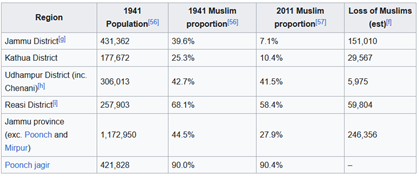
The table below compares the 1941 percentage of Muslim population with the present percentage for the Jammu region of Indian illegally occupied Jammu and Kashmir and gives figures for estimated ‘loss’ of Muslims, due to deaths as well as migration.
The sole purpose of the brutal massacre, orchestrated by Dogra soldiers, Indian troops and Hindutva RSS and Jansang forces was to turn the Muslim majority into a minority in Jammu, the report said, adding that under a conspiracy the Dogra army massacred lakhs of Muslims in Jammu in the first week of November in 1947.
It said the Jammu Muslims’ unparalleled sacrifices, which were written in golden letters in Kashmir’s history, will never go waste. It added that carnage of Muslims in Jammu was the ugly blot on the face of so-called Indian secularism.
The report maintained that the chain of sacrifices that started from Jammu in 1947 was continuing till today in IIOJK and so far over four hundred thousand Kashmiris had been martyred for demanding their right to self-determination. The Hindutva forces were trying to repeat the 1947 Jammu massacre in Kashmir as well, it added.
The report said that Kashmiris were determined to continue resisting Indian brutalities with courage and valor. It said that the people of Kashmir were destined to see the dawn of freedom.
The international human rights organizations, including the United Nations, must play their role in stopping genocide of the Kashmiris by Indian troops in occupied Jammu and Kashmir, the report said.