35 years on, justice continues to elude victims of Kunanposhpora mass rape
#Kunan_Poshpora_Mass_Rape
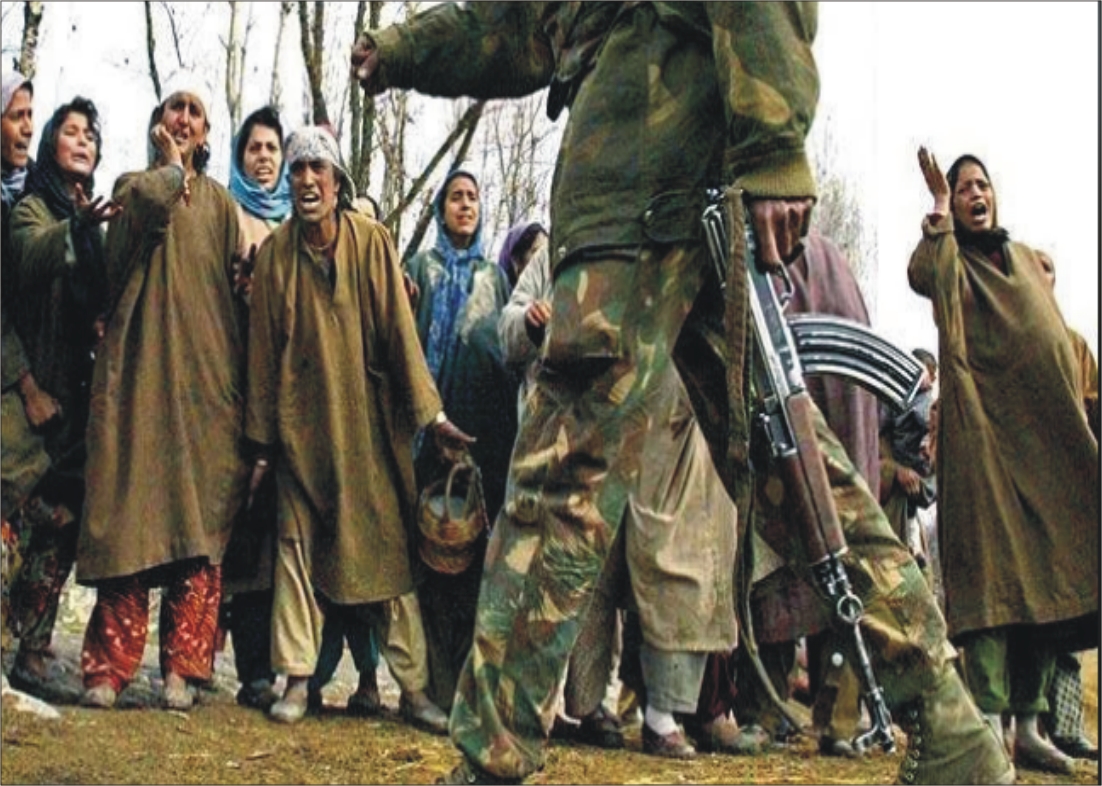
Islamabad: In connection with Kashmiri Women’s Resistance Day being observed today, the miseries and victimization of Kashmiri women by Indian forces and police personnel continue unabated in Indian illegally occupied Jammu and Kashmir.
A report released by the Research Section of Kashmir Media Service, today, said that at least 690 women have been martyred by Indian forces personnel from January 2001 to date in IIOJK. It pointed out that since January 1989, unabated Indian state terrorism has rendered 22,991 women widowed, while Indian forces personnel have molested 11,269 women in the occupied territory.
The Day is observed on both sides of the Line of Control every year to pay tribute to the struggles and sacrifices of the survivors of mass rape and torture in Kunanposhpora in Kupwara district of the territory. The call for observing the day as Women’s Resistance Day was first given by the Jammu and Kashmir Coalition of Civil Society and supported by the All Parties Hurriyat Conference in 2014.


On the intervening night of February 23 and 24, 1991, Indian troops gang-raped around 100 women of all ages, from eight to eighty years old, in the Kunanposhpora area of Kupwara during a siege-and-search operation.
The horrific memories of the incident are still fresh in the minds of the victims. “The memories of the horrific incident that shattered our lives continue to haunt us,” said a group of victims in a media interview. “Ironically, the troopers involved are yet to be punished despite evidence against them,” they stated.
While marking the anniversary of the incident as Kashmiri Women’s Resistance Day, the victims said it was an opportunity to raise their voice against what they described as India’s double standards and the silence of international organizations on the case.
The victims said that the incident changed the course of their lives. “Due to the mass rape, my body became partially paralyzed,” a victim said.
After the incident, one of the victims gave birth to a baby girl with a fractured leg on March 25, 1991. “After raping me, the Indian troopers kicked my abdomen, injuring my unborn baby. She was born with a fractured leg,” she said.
Villagers said that many victims suffered psychological disorders due to trauma. “Several victims died due to the non-availability of proper medical treatment and counseling,” they added.
The victims said that, like the Pathribal fake encounter case, the Indian troops involved in the gory incident have escaped accountability under the protection of the draconian Armed Forces Special Powers Act.
The report said that thousands of women lost their sons, husbands, fathers, and brothers in the occupied territory, many of whom were subjected to custodial disappearance by Indian Army, paramilitary, and police personnel.
It further pointed out that over three dozen women and girls, including Hurriyat leaders Aasiya Andrabi, Fehmeeda Sofi, and Naheeda Nasreen, are facing illegal detention in different jails of IIOJK and India. They are being victimized solely for representing the aspirations of the people of Jammu and Kashmir and their demand for the right to self-determination under United Nations resolutions, it added.
The report deplored that despite the passage of thirty-five years, justice continues to elude the victims, while the forces personnel involved in the heinous crime roam free under draconian laws. It said the impunity granted by India to its troops is the main reason behind tragedies like Kunanposhpora.
“Kunanposhpora mass rape is a glaring example of Indian troops’ brutalities in IIOJK. It is a blot on the so-called democratic face of India, which is using rape as an instrument of state terrorism in IIOJK. The Kunanposhpora tragedy is proof of institutionalized violence being used by India and of the war crimes perpetrated by Indian troops in Kashmir,” it said.
The report maintained that India has employed rape as a military tactic to humiliate Kashmiris and break their resolve for freedom. It said New Delhi must be pressured to reopen the Kunanposhpora mass rape case and bring the perpetrators to justice. India must be held accountable for the heinous crimes perpetrated by its troops against Kashmiris, it added.
The Indian Home Ministry in August 2025 banned and seized 25 books, including Do You Remember Kunan Poshpora? by Essar Batool.
“Books worth Rs 27,000 were seized from my shop,” said a bookstore owner in Srinagar’s Lal Chowk, requesting anonymity for fear of repercussions.
The books banned on August 5 documented Kashmir’s turbulent past and human rights violations, including rapes, torture, and extrajudicial killings in occupied Kashmir.
They include works such as Azadi by Booker Prize winner Arundhati Roy; Human Rights Violations in Kashmir by Piotr Balcerowicz and Agnieszka Kuszewska; Kashmiris’ Fight for Freedom by Mohd Yusaf Saraf; Kashmir Politics and Plebiscite by Abdul Gani Jabbar; and Do You Remember Kunan Poshpora? by Essar Batool. These books discuss rights abuses, massacres, and unfulfilled promises by the Indian state.
Other titles include Hafsa Kanjwal’s Colonizing Kashmir, journalist Anuradha Bhasin’s A Dismantled State: The Untold Story of Kashmir After Article 370, and legal scholar A. G. Noorani’s The Kashmir Dispute 1947–2012, which examine the region’s political trajectory over decades.
Critics say the government’s move to criminalize such literature is an attempt to redefine Kashmir’s history and erase its past.