98% of hate crimes against Muslims reported in BJP-ruled states in April 2026
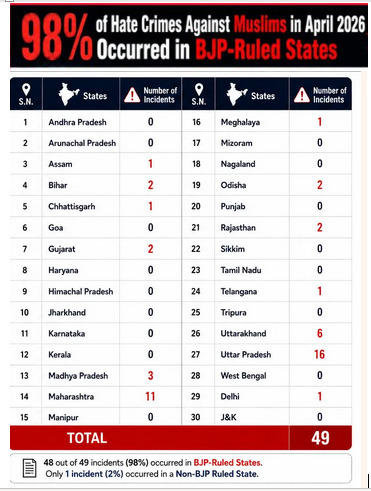
New Delhi: Since the BJP-led government took power in 2014, incidents of hate crimes targeting Muslims across India have shown a marked increase, according to monitoring reports from human rights organizations and civil society trackers.
According to Kashmir Media Service, a vast majority of anti-Muslim hate incidents—including hate speech, vigilantism, and violence—occur in states governed by the BJP. However, civil society monitors note that there is no official government data confirming that exactly 98% of physical hate crimes occurred in BJP-ruled states in April 2026.
Reports indicate that approximately 85% of these incidents involve individuals affiliated with the BJP or its allied Hindutva organizations. In many cases, Indian police and agencies have responded with indifference or hostility toward victims seeking help.
The reports are dedicated to systematically documenting all hate crimes committed against Muslim community in BJP-ruled India.
Independent monitoring groups and human rights trackers have documented recurring patterns in recent years. Organizations like the India Hate Lab have previously reported that a large majority of hate speech and intimidation incidents (often around 88% to 93% depending on the period) take place in states ruled by the BJP.
Early 2026 data from the India Persecution Tracker documented at least 13 killings of Muslims in religiously motivated crimes across eight states during the first four months of 2026. These fatalities were heavily concentrated in states like Bihar, Jharkhand, and Uttar Pradesh, all of which are governed by the BJP or its political allies.
Civil society monitors further note that April of recent years consistently records spikes in communal tensions and inflammatory incidents, which are often amplified during religious processions or political rallies. Incidents documented in April 2026 include highway assaults on Muslim transport workers and cases of targeted harassment within neighborhoods
Meanwhile, the UN treaty bodies and special rapporteurs have repeatedly called for international attention to the human rights situation in India, mostly through the Committee for the Elimination of Racial Discrimination (CERD) Early Warning and Urgent Action mechanism. In fact, there have been 91 communications regarding human rights violations in India from UN mechanisms during 2020-2026.
However, these interventions have had little impact, which critics attribute to India’s disregard for its treaty obligations, as well as the international community’s failure to enforce accountability from member states, including within the UN Human Rights Council, of which India continues to be a member.