They want us to remain homeless’: J&K’s Gujjars, Bakerwals fear eviction despite FRA
Tarushi Aswani
While the Narendra Modi-led Indian government claimed that removing IIOJK’s special status would help tribal communities because of the Forest Rights Act being implemented, the actual benefits of the Act still evade most people.
Rajouri (IIOJK): It is a sunny but breezy day in Jammu’s Rajouri district. People are leaving for work, children are ready in their school uniforms, and groups of goat and sheep herders are preparing to take their cattle grazing.

Suddenly, tensions grip the border district when news spreads of dozens of homes belonging to Gujjar and Bakerwal families being demolished in Jammu’s Sidhra area.
The demolition on May 19 in Sidhra left at least 30 tribal families homeless, triggering allegations that vulnerable Muslim communities were being selectively targeted.
As per the 2011 Census, Scheduled Tribes comprised more than 14 lakh of the total 1.25 crore J&K population. These numbers would have changed, since no Census was conducted in 2021, after the 2019 move to bifurcate the state into two union territories. But it is this population that has been left in a legal lacunae, unable to claim their own homes.
After 2019
While the marginalisation of tribal communities in J&K goes back decades, nomadic people have been facing an exacerbated level of harassment and eviction in recent times. J&K is home to 12 Scheduled Tribes, with the Gujjars and Bakerwals being the largest tribal groups in the majority of districts of J&K. These communities are concentrated in Doda, Poonch, Rajouri and Reasi districts of Jammu. Among this Scheduled Tribe population, a majority are Muslims.
In October 2019, barely two months after Article 370 and 35A were read down by the Narendra Modi government, the Union extended the Scheduled Tribes and Other Traditional Forest Dwellers (Recognition of Forest Rights) Act, 2007 to J&K. This Act was one of the 106 central laws which were made applicable to J&K. The law – known as the Forest Rights Act or FRA – is meant to insulate tribal groups from eviction from forest dwellings. It also legalises their rights such as access to water resources, pastures for cattle grazing, permission to undertake forest-based livelihoods and undertaking minor cultivation within forests.
Landless tribals assumed that they would now get to legally claim the rights they had been fighting for for decades. But the implementation of the law has not begun on the ground even after the passage of nearly seven years. Those who the law was meant to serve are caught between a tug of war between the local government and the LG’s administration.
On the ground, in Rajouri’s Plangarh for instance, the fight for the FRA means much more than simple access rights. Those living in Plangarh, a village dominated by Gujjars, feel that rights are easily granted on paper – but rarely delivered in person.
Demolition over democratic rights
In September 2021, Jammu and Kashmir Lieutenant Governor Manoj Sinha handed over individual and community rights certificates to people from the Gujjar, Bakerwal and Gaddi Sippi communities under the FRA at an event in Srinagar.
“That actually motivated many of us to apply. In 2021, several people from Thanamandi applied. We only got FRA in 2019, while other states had it decades before us. Even six years after it was applied to J&K, you can’t even say 5% tribal families got claims,” Irfan Anjum, a political activist from Plangarh, told The Wire.
Basharat Hussain, a local rights activist, echoed this claim, saying that most applications have been ignored.
“You know if we need to make a road between two villages and the area happens to be on forest land, we are asked to claim rights on the patch of land through the FRA to seek road construction to make the commute easier. So today, we don’t have the road we really need because of stuck files and slow procedures,” Anjum added.
Before the FRA was extended to the region, anybody seen as forest dwellers was labelled as illegally encroaching on forest land. Here, the FRA allotted forest dwellers legal rights to the land they had been living and cultivating on for generations.
The Act mandates that no member of a forest-dwelling Scheduled Tribe or other traditional forest dwellers “shall be evicted or removed from the forest land” under their occupation without a recognition of their rights. With the FRA, Scheduled Tribes or other traditional forest dwellers are entitled to fair compensation in case of state-enforced displacement.
However, social activists in Jammu and Kashmir said that even in November 2020, local officials conducted demolition drives and issued show cause notices for eviction to forest-dwelling Gujjar and Bakerwal communities. Just as with the recent demolition in Jammu’s Sidhra, where JCBs arrived with the first rays of the sun.
For Mushtaq Ahmed, each tick of the clock brings uncertainty because his claims have not yet been approved. “I don’t know when they will powder my home. I am both sleepless and breathless,” said Ahmed, a resident of Plangarh. Ahmed has lived in his mud-brick house for over six decades, but has never had proper documentation or ancestral records for his house. Though he has submitted his claims to the Forest Rights Committee – a committee meant to act as a bridge between claimants and the Gram Sabha – he remains uncertain about whether his documents will be approved.
About 160 km away in Kashmir’s Shopian, Choudhary Fazil-ud-Din Deedad is the District Development Council (DDC) Member for Keller. Deedad, also from the Gujjar community, feels that tribals in the region are being made to run from pillar to post for their basic rights.
“It only dawned upon the administration recently that we were to pledge our claims to the tribal department and not the forest department. Since 2019, many of us have been writing to the forest department. They don’t see us as a significant vote bank, so our rights don’t mean much to them,” Deedad told The Wire.
Deedad is talking about the LG order of December 2025, which mandated that the tribal affairs department would now act as the nodal department for implementation of the FRA in J&K.
“So were we basically being made to run to the wrong people? I feel they want us to remain homeless,” he added.
Politics of pastures
With families, food, homes, cattle movement and even income dependent on their seasonal movement from the mountains to the mainland and then again back to the mountains, the region’s tribes live a life dictated by the weather.
“We don’t know any other form of life and I don’t think we would be happy doing anything else,” said Basharat Hussain.
But when governments govern grasslands and pastures, pastoralists’ living often becomes dotted with unfriendly systems and procedures.
During The Wire’s visit to Rajouri and Poonch, several members of Gujjar and Bakerwal communities shared how they were being made to apply for grazing permits online.
Historically, Gujjar and Bakerwal communities have also been moving between the Jammu division and Kashmir division using the matto – a written permit for movement from tehsildars. But the new digitisation of routes stirs many questions from the community.
“A major chunk of our pastoralists’ community is illiterate, many don’t use phones, some don’t understand what the internet is, it is unreasonable how we are being pushed towards this digitisation,” Irfan Anjum told The Wire.
Rajouri’s Gujjars connect this to the four-day near-war situation between India and Pakistan last year.
“It was this year in the beginning that these permits began being digitised; we were asked to also download an app to get these permits done. It was a task to even find the app in the first place and to get it to work. We think they want us to quit our nomadic cross-division movement so they are making things difficult for us,” a member of the community said.
Gujjars across Poonch and Rajouri shared with The Wire that keeping up with the digitisation of their lifestyle is getting even more cumbersome than their seasonal movements. “We need to fill forms online, listing the breed, number, color of our animals. We fully try to cooperate, we pay the requisite movement tax, yet we are seen as suspects,” one said.
Gujjars in Jammu feel that violence and harassment towards their community has grown multifold since the Kathua rape case.
In April, Tanveer Ahmed Chopan from Jammu’s Ukhral was coming home from Jammu with cattle in a pickup vehicle when, at Digdole near Ramban on the Jammu-Srinagar highway, a group of ‘cow vigilantes’ in two vehicles started chasing him. The men managed to intercept Tanveer near Nagarkot and started assaulting him. He ran down the road and jumped into the nullah flowing along the highway to escape. His body was recovered 20 days later, nearly three kilometres from where he had disappeared on April 12.
In early 2025, Makhan Din, belonging to the Gujjar community, died by suicide hours after he was allegedly tortured in police custody in Jammu’s Kathua.
In Poonch, Gujjars also recall the incident of December 2023 in hushed voices – when locals picked by 48 Rashtriya Rifles were allegedly brutally tortured, videos of which later emerged, sending shockwaves across the region. Later, when families received the dead bodies, they were convinced that their kin died of custodial torture.
Awaiting addresses
Ever since Jammu’s Sidhra became an example of the rightlessness that the tribals in the region face, the community, who have undertaken their bi-annual migration between the plains and highland pastures over centuries, feel a wave of challenges restricting their traditional activities.
About the uncertainty that tribals face in forests, The Wire spoke to Javed Ahmed Rana, Minister for Jal Shakti, Forest & Tribal Affairs, J&K, who says he is outraged by the unilateral demolition of homes in Sidhra by the LG administration. “Decades of heritage of our innocent Gujjar-Bakarwal families have been reduced to rubble without taking the elected, popular government or my ministry into confidence,” Rana said.
Rana told The Wire that though the FRA was extended to J&K in 2019, the benefits of the Act on ground are negligibly received. “Not even 500 families across J&K have received claims under the FRA. Maximum cases are pending at DC levels; if you visit Shopian, there are piles of pending files in the office; the Act was extended but not implemented properly. I am continuously taking meetings to understand people’s cases and further the implementation,” he explained.
Rana also elaborated that between 2019 and 2024, J&K had no elected government, and this too halted many operations and implementations. “After 2019, those who claimed to have gifted land rights to tribals have done nothing more than give speeches. They have done to Gujjars, Bakerwals, what they have done to the rest of India. But I am on it and I have constituted two committees to look into who is accountable for Gujjars being ousted in Sidhra,” he said.
Zahid Parwaz Choudhary, president, Gujjar Bakarwal Youth Welfare Conference J&K, feels that there is a link between those who await claims to be fulfilled and the demolitions in Sidhra. “The FRA says that until implementation is underway, tribals cannot be evicted, but evictions have actually shot up since 2019. These demolition conductions are very much likely to be slapped with SC/ST Atrocities Act. We want to drag those accountable to the high court, how have they unhoused 30 families without providing notices?” Choudhary told The Wire.
“Even their Holy Quran was under the debris, they weren’t allowed to drag even one piece of cloth out of their homes. They are silencing those who are already voiceless,” he added.
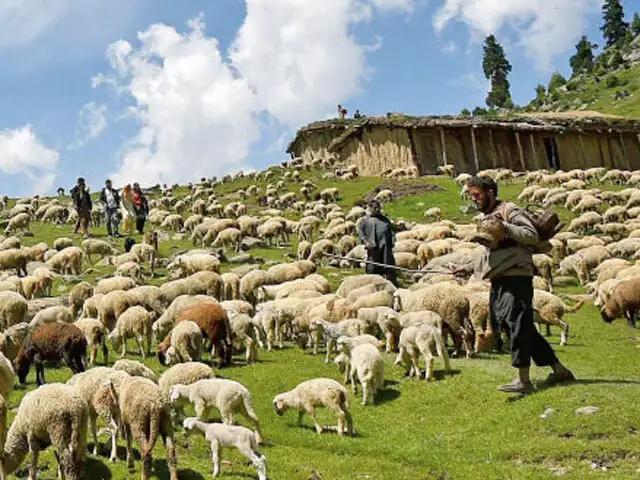
The Gujjar and Bakarwal communities are the primary nomadic and pastoralist tribes residing in the Pir Panjal Range. Photo: Tarushi Aswani
The Wire has reached out to J&K LG Manoj Sinha to ask about the demolitions in Sidhra, the implementation of the FRA in J&K and the number of claims pending under the Act. This article will be updated when a response is received.
On August 15, 2019, Prime Minister Narendra Modi deplored Kashmir’s political autonomy and said, “The old arrangement in Jammu, Kashmir and Ladakh encouraged corruption, nepotism, there was injustice when it came to rights of women, children, Dalits, tribal communities.” But today, Choudhary asks, “What justice have we got since then? BJP’s own MLAs call us encroachers, do they not remember the PM’s speech?”
As Gujjar families in Sidhra continue to live under clumsy tents, their children missing school books, toys and a chance at a better life, back in Rajouri, local activists’ phones are buzzing with even more questions, queries and fear about what the administration might take away – and what the FRA can heal.
(The writer is an independent journalist.)