Article: Kulgam Operation: A Case Study in India’s Incompetence and Propaganda
 By: Arshad Mir
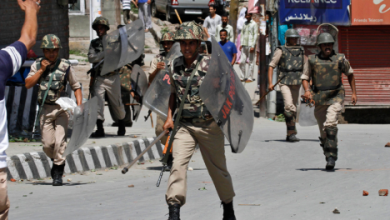
In the occupied Jammu and Kashmir’s southern Kulgam Operation district of Kulgam, the Indian Army has been conducting a massive operation in the upper Akhal region for the past two weeks now. The operation involves a huge deployment of army troops, paramilitary forces, police personnel, and elite Para commandos, along with bomb-proof, armored, and high-intensity lighting vehicles, as well as choppers and drones, all used on a war-like scale.
The scale of the operation is evident from the fact that the Northern Command chief, Lieutenant General Prateek Sharma, and Police Chief Nalin Prabhat have both visited the area, assessed the situation, and motivated the troops. The Indian Army claims that militants are hiding in the dense forests of the region, leading to a prolonged encounter.
As in numerous similar past operations, the local population has been forcibly evacuated, while the media has been kept 10 kilometers away, making it impossible for independent sources to report on the developments. Whatever the Indian Army feeds to its media becomes the “news.”
Even so, this operation has exposed the Indian Army in several ways and raised numerous questions that, if no one else, the Indian public should at least be asking.
The operation, which began last Friday, has seen multiple claims by the Indian Army of having inflicted damage on the alleged militants. For example, on August 8, the Chinar Corps of Indian Army stated in a press release that two alleged militants had been killed and two Indian soldiers injured. However, due to the rains and dense, inaccessible forest, neither the bodies of the slain militants were recovered nor could they be identified.
On August 9, another press release claimed that two soldiers and one “terrorist” had been killed, yet again without the recovery or identification of the militant’s body.
This is not the first time the Indian Army has had to conduct a weeks-long, full-scale military operation against what it describes as “a few trapped militants.” There are many similar examples:
In January 2009, the Indian Army carried out a nine-day operation against such “trapped militants” in which it confirmed the deaths of four of its soldiers (including one JCO) and claimed to have killed four Mujahideen. Yet, it admitted that their bodies were not recovered from the encounter site. The operation was ended on the tenth day.
Nearly 13 years later, in October 2021, a similar operation was launched in the Dera Ki Gali forest area of Surankote tehsil, Poonch district. This operation lasted for two weeks. By the Indian Army’s own account, nine of its personnel, including two JCO’s, were killed. The operation saw heavy use of troops, Para commandos, paramilitary forces, helicopters, drones, and other war equipment.
Indian newspapers such as The Hindu reported at the time:
“Drones and advanced weaponry are being used to locate terrorists hiding in the forest, but there is no clear information on the ground situation. The army has only issued written statements so far, and journalists are not being allowed within 11 km of the encounter site.”
The prolonged nature of the operation and the lack of tangible results led to speculation in the Indian media that:
“It is possible that the prolonged deployment of the Indian Army in eastern Ladakh due to tensions with China has weakened the counter-infiltration grid along the Line of Control in Jammu & Kashmir.” (The Hindu)
To cover up, the Indian Army even fed the press a story, saying:
“The area consists of dense forests, and according to experts, the intensity of the firefight suggests that a large group of terrorists is present. Some experts believe the ground operation is possibly being led by Pakistani Army officers.”
The then Indian Army Chief, General M.M. Naravane, visited the area, assessed the situation, stayed for two days, and then returned to Delhi. After this, the army began its so-called “final action”, which turned out to be the staged killing of Zia Mustafa, a citizen of Rawalakot, Azad Kashmir, who had been imprisoned in Kot Bhalwal Jail for 14 years.
The army claimed that Zia was being taken to the area to identify his “associates” who opened fire resulting in the killing of Zia.
Was it possible that Mustafa had maintained contact with his “associates” from jail, and that they had been operating in the same area for 14 years, still recognizable to him? Was there no change in the militant ranks over such a long period?
Was the mighty Indian Army so incompetent that it could not eliminate Mustafa’s “associates” in 14 years?
At the time, neither the Indian media nor the public asked these questions, and they still are not being asked today regarding Kulgam operation.
Before even questioning whether these encounters are genuine, one must first ask about the competence of the Indian Army.
Is it acceptable to any that the world’s second-largest army by manpower and the fourth-strongest in weaponry, with nearly seven decades of counter-insurgency experience in occupied Jammu & Kashmir and India’s northeastern states, is so inept that it requires days or even weeks to neutralize a handful of poorly armed, untrained militants, despite having them completely surrounded?
Who will answer this Himalayan-sized question that where do these Mujahideen or “Atankeez,” besieged for weeks, get their food, water, and ammunition to keep fighting? How do they meet basic physical needs, including sleep? Are they robots?
Who actually are they? Where do they come from? Where do they get their training and weapons? How many have ever been to Pakistan?
If the Indian government genuinely wants to know, and to prove it to the world, why not invite an international agency to investigate? At the very least, determine what proportion of Kashmiri youth have taken up arms since 9/11, whether they are locals or outsiders, and, most crucially, why have they picked up arms in the first place?
It is important to recall here that when Mehbooba Mufti was Chief Minister of J&K, she presented detailed written answers in the state assembly showing how much and what type of weaponry had gone missing from government armories in recent years, and how many weapons had been snatched from police and security personnel. Has there ever been a serious investigation into where these weapons went, who obtained them, and who within the system was selling arms from government stockpiles?
If, according to Indian allegations and propaganda, all of this is orchestrated by Pakistan and these are “terrorists” sent from Pakistan, then why are they almost always killed in military operations instead of being captured alive, especially when capturing them could substantiate India’s narrative and accusations?
A recent example is the fake encounter at Dachigam, Srinagar, wherein the three killed “terrorists” were accused of murdering tourists in Pahalgam. They were declared Pakistani on the grounds that voter cards and chocolates were recovered from them, although Pakistanis do not have voter cards, and chocolates could not possibly remain fresh for such a long time. There was no investigation, no judicial process, no forensics, no DNA testing, no credible identification, merely the declaration that they were Pakistani. And if someone in Parliament questions how they were determined to be Pakistani or how this encounter is beyond suspicion, they are silenced with: “Do you not trust the statement of our Army, Home Minister, and Defence Minister?”
Yet, on numerous occasions, the Indian Army, government, and media have themselves claimed that infiltration has stopped entirely. For example:
In October 2007, Lt. Gen. T. K. Sapru, Commander of 16 Corps (Nagrota), said that due to effective fencing and surveillance, infiltration had been brought down to “almost zero.” (Source: UPI)
In June 2011, Lt. Gen. Syed Ata Hasnain, Commander of 15 Corps, said that for the first time in 20 years, infiltration into the Kashmir Valley was “zero” and that no militant had crossed over that year. (Source: The Indian Express)
In 2015, Lt. Gen. Subrata Saha, Commander of 15 Corps, stated that for the first time since the beginning of the insurgency in Kashmir, not a single infiltrator had entered the Valley in the past seven months. (Source: The Indian Express)
In April 2021, The New Indian Express reported that for the second consecutive year, infiltration across the Line of Control during the first three months of the year was “zero,” owing to advanced anti-infiltration measures and heavy snowfall in winter.
So why continue blaming Pakistan?
Is it simply an easy way to cover up incompetence, or the perfect method to “justify” military spending?
If, from 2007 to 2021, a span of 14 years, Indian Army commanders publicly confirmed no infiltration, then whom did the army kill in its operations, and on what basis did the government keep accusing Pakistan?
India’s 2011 census estimates the number of Kashmiri youth aged 16–30 to be 3.4 million. The Indian Army recently claimed that only 80 militants remain active in Jammu and Kashmir. If we calculate the percentage, 80 out of 3.4 million is just 0.000024%. Is this minuscule percentage enough to justify imposing a 1-million-strong force over the entire Kashmiri population and subjecting them to relentless oppression?
Does it make any sense to deploy a million troops and wage massive, round-the-clock, costly operations against only 80 fighters?
Does this not prove that India’s real fight is with the entire Kashmiri nation, since all Kashmiris seek freedom, and militancy is merely used as a pretext?
It is said that in the past 35 years, at most 60,000 Kashmiri youth have ever taken up arms, just 1.76% of the total. Yet, even with 1 million troops, draconian laws, and absolute freedom to commit atrocities, India has failed to eliminate even this small fraction in three and a half decades. Where, then, does the responsibility for this failure lie?
Is this not shameful incompetence? And is propaganda against Pakistan simply a way to hide it?
How long will India continue to shield itself behind accusations against Pakistan and falsely portray the Kashmiris’ legitimate, indigenous movement as foreign-sponsored terrorism?
The tendency of India’s political and security establishment to implicate Pakistan in every domestic problem is part of a calculated narrative designed to inflame public sentiment, silence dissenting voices, and mask its own failures. While this may bring short-term political gains, in the long run, it damages India’s credibility. Repeated baseless accusations not only raise doubts about its investigative and governance capabilities but also give the impression that the “world’s largest democracy” cannot solve its own problems. In this way, India only exposes its own shortcomings.