The census, in the canonical tradition of political sociology, has never been a purely administrative instrument. As Benedict Anderson observed in his seminal work on nationalism, the census does not merely count populations, it categorises them, fixes them into legible identities, and renders them governable. Nowhere is this observation more consequential than in contested territories, where the act of enumeration carries the weight of sovereign claim. Indian illegally occupied Jammu and Kashmir’s (IIOJK) forthcoming Census 2027, the first to be conducted since the abrogation of Article 370 in August 2019 and the subsequent legislative redefinition of domicile, presents precisely such a case. It is an exercise in which the political and the statistical are not merely intertwined but structurally inseparable, and in which the question of who is counted cannot be divorced from the prior question of who was permitted to belong.
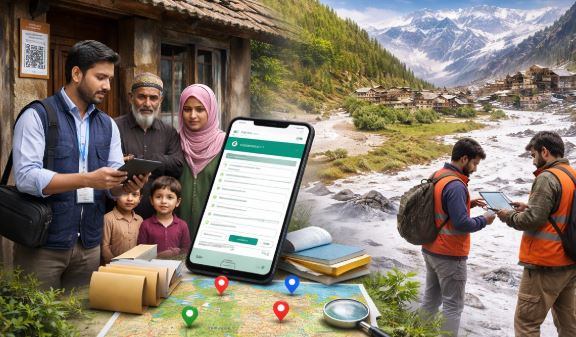
On the surface, it is a counting exercise; households, ages, occupations, religions. But in a contested territory, a census is never merely that. It is a mirror held up to a political reality, and in IIOJK, that mirror has been carefully repositioned before anyone has even looked into it. This census, arriving at the precise intersection of a contested legal transformation and an unresolved political dispute, maybe the most consequential counting exercise the territory has ever witnessed. Occupied Jammu and Kashmir is set to begin the first phase of India’s Census 2027 in June 2026, with houselisting and housing enumeration scheduled from June 1 to June 30, and a self-enumeration window running from May 17 to May 31. The snow-bound areas will follow in September 2026, with population enumeration covering detailed demographic, socio-economic, migration, and fertility data, alongside caste enumeration. The exercise is historic in its ambition, the first fully digital census in Indian history. But in Kashmir, it arrives at an extraordinary moment. The rules governing who counts as a resident, who can own land, and who belongs here have been fundamentally rewritten in the years preceding it. The census will not simply measure a population. It will measure the consequences of a legal transformation.
The story begins on August 5, 2019. On that date, the Indian government rendered Article 370 of the Constitution inoperative, stripping IIOJK of its special autonomous status and bifurcating it into two Union Territories,Jammu and Kashmir, and Ladakh — both placed under direct federal rule. With Article 370 went Article 35A, the provision that had for decades reserved land ownership and government employment exclusively for permanent residents of the region.The Jammu and Kashmir Re-organisation (Adaptation of State Laws) Order, issued on March 31, 2020, redefined the concept of domicile entirely shifting it from an identity-based framework to an “open to all” category, extending eligibility to non-state subjects who met residency criteria. Under the new definition, children of central government employees who had served in J&K for ten years, even if those children had never themselves lived there — qualified for domicile status, as did migrants registered with the Relief and Rehabilitation Commissioner. Land could now be transferred to non-residents who could then permanently settle in the territory. According to the 2011 Census, the last one actually conducted, Jammu and Kashmir was approximately 68.3 percent Muslim and 28.4 percent Hindu. That demographic arithmetic has long been politically charged. Any shift in those numbers, however modest, will be scrutinised intensely. The numbers themselves may not lie, but the boundaries drawn around who gets counted carry enormous weight. There is also the matter of administrative geography. All administrative boundaries in occupied Jammu and Kashmir have been frozen from January 1, 2026 to March 31, 2027 to ensure census consistency. This freeze locks in a district and tehsil map that was itself redrawn after 2019 — boundaries that, critics argue, were designed to dilute Muslim-majority concentrations in certain constituencies. A census does not merely capture reality. It constructs it, lends it official weight, and feeds it into decades of policy planning, delimitation of constituencies, allocation of resources, welfare targeting, representation. In a territory whose political future remains deeply uncertain and contested, the 2026–27 enumeration in Jammu and Kashmir is not a neutral bureaucratic exercise. It is a political act dressed in the language of governance.

The writer is pursuing BS International Relations from Khan Abdul Wali Khan University and is Intern at Kashmir Institute of International Relations. He can be reached at
[email protected]