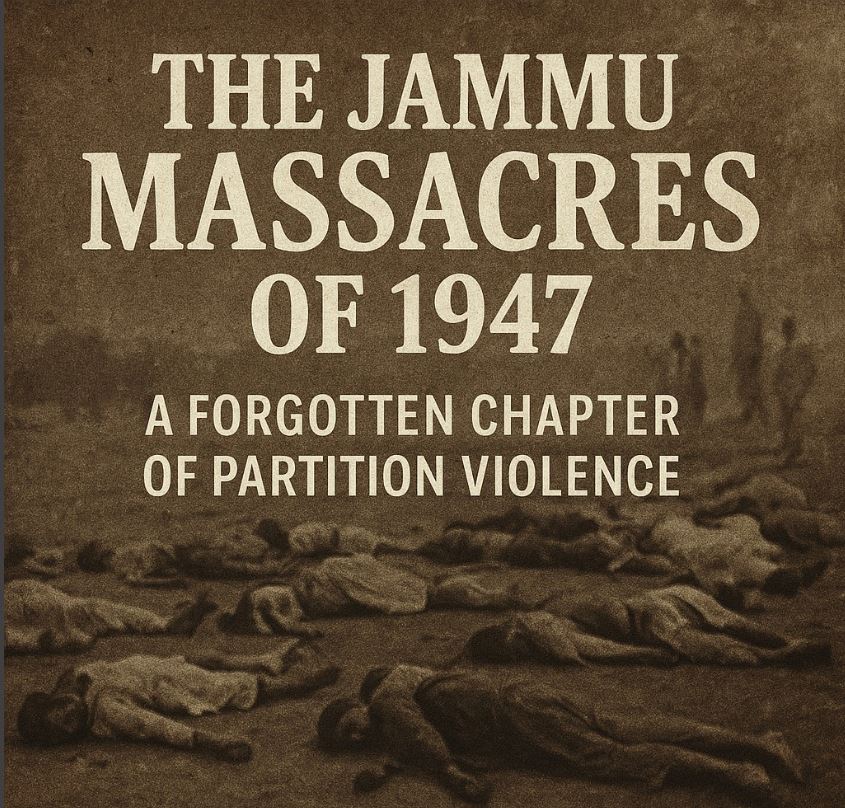
Each year on November 6, Kashmiris mark Jammu Martyrs’ Day to remember the thousands of Muslims killed in the Jammu Massacre of 1947, an episode of ethnic cleansing so vast in scale that historians regard it as one of the bloodiest but least acknowledged tragedies of Partition. While the violence of 1947 in Punjab and Bengal is widely documented, the systematic extermination and expulsion of Muslims from Jammu remains largely absent from international narratives, buried beneath geopolitical debates that followed.
The roots of the massacre lie in the turbulent months following the partition of British India, when the princely state of Jammu and Kashmir ruled by Maharaja Hari Singh, a Hindu monarch in a Muslim-majority region became a flashpoint between India and Pakistan. Economic repression had already triggered unrest: Muslim soldiers returning from World War II, particularly in the Poonch district, launched a “no tax” revolt against the Maharaja’s burdensome levies. Rather than de-escalate, the administration disarmed Muslim populations, deployed Dogra troops, and strengthened the position of Hindu and Sikh militias, leaving Muslims exposed to the communal violence that soon erupted.

The violence that unfolded from October to November 1947 was not spontaneous anarchy but a coordinated project of demographic elimination. Eyewitness and journalist Ved Bhasin recalled how Sikh militants “paraded the Jammu streets with their naked swords,” terrorizing neighbourhoods as Dogra forces looked on, while the Rashtriya Swayamsevak Sangh (RSS) organized armed cadres to carry out targeted assaults (Sankara Narayana, “The Untold Story of Jammu Massacre,” Clarion India, February 18, 2023). Historian Victoria Schofield, citing Ian Stephens, then editor of The Statesman (Calcutta), describes how “systematic savageries… practically eliminated the entire Muslim element in the population, amounting to 500,000 people,” noting that nearly 200,000 “just disappeared, remaining untraceable, having presumably been butchered or died from epidemic or exposure,” while the remainder fled to West Punjab (Victoria Schofield, Kashmir in Conflict: India, Pakistan and the Unending War, London: I.B. Tauris, 2003, p. 43).
Christopher Snedden similarly argues that the massacre served both ideological and material motives: looting and pillage were widespread, but there was also what many victims understood as a premeditated plan to remove Muslims from Jammu altogether. Citing a Government of Azad Kashmir publication, Snedden notes claims that the Maharaja intended to eradicate Muslims due to their pro-Pakistan sentiment and to populate the region instead with Sikh refugees from Western Punjab. He suggests that the violence in Jammu’s eastern districts’ areas with Muslim minorities appears consistent with a strategy to redraw the region’s demography by forcing Muslims west of the Chenab River (Christopher Snedden, The Untold Story of the People of Azad Kashmir, Oxford University Press, 2012, pp. 48–49).
The massacre was not only recorded by historians but even acknowledged in real time by figures like Mahatma Gandhi. Speaking at a prayer meeting in November 1947, Gandhi lamented: “Even though in Jammu recently the Muslims were killed by the Hindus and the Sikhs, [Sheikh Abdullah] went to Jammu and invited the evil doers to forget the past,” confirming that the killings were both known and undeniable (A.G. Noorani, “Why Jammu Erupts,” Frontline, September 25, 2008).
The scale and brutality were staggering. Reports describe more than 100 trucks filled with unarmed Muslim civilians women, children, and the elderly transported toward the forests of Kathua under the false assurance of safe passage to Pakistan. Once deep inside the woods, they were massacred by armed extremists while the Indian Army, already deployed in parts of the state, stood by without intervention. Other fleeing groups were ambushed along the Suchitgarh–Sialkot route; survivors recounted how people were killed in droves, their valuables looted, women raped, and bodies left unburied. In a single day, more than 25,000 Muslims gathered at Miran Sahib and Ranbir Singh Pora were machine-gunned in cold blood. Eyewitness Amanullah Khan Naqshbandi later described how people were deceived into boarding “evacuation” convoys, only to be slaughtered en route (“Amanullah Khan’s Heart Wrenching Account of the Jammu Massacre of 1947,” Indus News, November 6, 2019).
Alastair Lamb’s research shows that the Jammu region was “practically emptied of Muslims” as a result of the massacre, its population altered so drastically that it reshaped the political and communal landscape of the state for decades to come (Alastair Lamb, Birth of a Tragedy: Kashmir 1947, Roxford Books, 1994, p. 69). That demographic transformation continues to have geopolitical significance, as the altered population balance later strengthened pro-India political currents in Jammu and allowed New Delhi to project the region as a Hindu-majority counterweight to the Muslim-majority Kashmir Valley.
This is why Jammu Martyrs’ Day is not only a day of remembrance but a reminder of unresolved justice. Pakistan and Azad Kashmir observe November 6 as Youm-e-Shuhada-e-Jammu, using it as a platform to demand that the world acknowledge both the historical massacre and the ongoing repression in Indian-administered Kashmir. For Kashmiris, the erasure of the Jammu Massacre from Western consciousness is not accidental but reflects what many call a selective moral standard governing which victims of Partition are remembered and which are ignored.
The legacy of 1947 is not frozen in history. Analysts argue that the BJP government’s policies including the abrogation of Articles 370 and 35A, revocation of statehood, and new rules enabling non-locals to acquire land and domicile rights represent a modern continuation of the demographic engineering that began in Jammu nearly eight decades ago. The same logic that expelled hundreds of thousands in 1947, critics argue, now aims to marginalize Kashmir’s Muslim majority through legal, demographic, and administrative redesign rather than militias and mass killings.
Yet the world has still not formally recognised the Jammu Massacre as an act of ethnic cleansing. The silence surrounding it contrasts sharply with the global attention given to other twentieth-century mass atrocities. Survivors and their descendants continue to call for acknowledgement, compensation, and at minimum, historical honesty. Their testimonies like those of Naqshbandi and other eyewitnesses remain essential not just as archives of grief, but as evidence of state-enabled violence that has never been prosecuted.
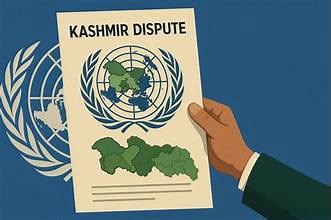
As Pakistan and Kashmiris around the world mark Jammu Martyrs’ Day again this year, the demand is not only remembrance but accountability. The massacred of 1947 were denied justice in their lifetimes; allowing their erasure now completes the violence that began with their deaths. To remember them is to insist that history cannot be rewritten to suit the powerful. It is also to affirm that the right of self-determination, still denied to the people of Jammu and Kashmir, did not emerge from abstract UN resolutions but from graves, refugee columns, burned homes, and the unmarked mass killings of 1947.
The world may have forgotten Jammu. Kashmiris have not. And as long as November 6 is observed, neither will history.