From Instrument of Accession to Security Council Resolutions: Kashmir as a Test of International Law
Amir Mushtaq

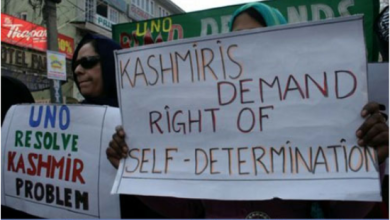
 Few disputes have remained on the Security Council’s agenda as long as Kashmir, and few show so clearly the gap between what states promise and what they do. The 27 October 1947 landing of Indian troops in Srinagar is not merely an anniversary. It is the starting point of a legal and moral question that remains unanswered seventy-nine years later: whether the people of Jammu and Kashmir have ever been allowed to decide their own future. From the perspective of Pakistan and advocates of Kashmiri self-determination, the record answers no, and it shows a pattern of selective commitment to international law.
At Partition, princely states were expected to join India or Pakistan on the basis of geography and the wishes of their people. Jammu and Kashmir had a Muslim majority of roughly three-quarters, a border with Pakistan, and rivers and roads that led into Punjab. Maharaja Hari Singh, a Hindu ruler, delayed his decision and pursued what critics describe as a dual policy. He offered standstill agreements to both dominions, Pakistan accepted, and India did not sign. Meanwhile unrest grew, including the Poonch uprising against heavy taxation. When the crisis deepened in October, he fled his capital and asked India for military help. India’s account is that he signed the Instrument of Accession on 26 October. Pakistan’s objection is that an accession signed by a ruler who had lost control of his capital, and who needed an army in return, was obtained under duress. In legal terms, consent given under such pressure is a weak foundation for permanent sovereignty, and it certainly does not represent the will of the population.

India then reinforced the commitment by taking the dispute to the United Nations on 1 January 1948 under Chapter VI of the Charter. This detail is central. The plebiscite was not imposed on India by a hostile forum; India invited the Council to deal with the matter. Resolution 39 created the UN Commission for India and Pakistan, and Resolution 47 of April 1948 laid out a sequence of ceasefire, withdrawal, and a plebiscite under a UN-appointed administrator. The UNCIP resolutions of August 1948 and January 1949 confirmed that accession would be decided by a free and impartial vote, and Resolution 122 of 1957 held that assembly elections could not replace it. A ceasefire took effect in January 1949, but the demilitarisation phase never followed and no plebiscite has ever been held.
Over the decades, India moved from promising a plebiscite to declaring the question closed. It pointed to the state assembly’s ratification, argued that Chapter VI resolutions are only recommendations, and later invoked the 1972 Simla Agreement to describe Kashmir as a bilateral matter. In August 2019, it revoked Article 370 and split the territory into two union territories. Pakistan argues that a bilateral agreement cannot cancel obligations owed to the Security Council and to the people concerned, and that the 2019 step moved further from the settlement the Council envisaged. Critics link this political denial to a harsh security regime, citing the Armed Forces Special Powers Act, preventive detention under the Public Safety Act, and reports of enforced disappearances. The UN human rights office documented concerns in reports published in 2018 and 2019.
The dispute is not a matter of history alone. On 31 August 2026, a Court of Arbitration in The Hague ruled that India cannot unilaterally suspend the Indus Waters Treaty, rejecting every argument New Delhi used to hold it “in abeyance.” India categorically rejected the ruling. Prime Minister Shehbaz Sharif told the General Assembly that any attempt to stop or divert Pakistan’s share of the waters would be treated as an act of war, and Foreign Minister Ishaq Dar has asked the Security Council to press India to comply, under the agenda item “India-Pakistan Question.” For Pakistan, the two cases share one logic: a state that steps away from the Council’s record on Kashmir and from a binding arbitral award on water is treating international law as optional.
Why, then, does the dispute remain unresolved? The key resolutions were adopted under Chapter VI, which is advisory, so the Council lacks enforcement power without Chapter VII. Great-power interests shield larger and more strategic states from pressure. Nuclear deterrence makes full war too costly, producing the stability-instability paradox in which strategic calm coexists with violence at lower levels. India’s insistence on bilateralism excludes outside mediation, while a classic security dilemma leaves both sides unwilling to demilitarise first. Domestic politics on both sides rewards hard lines and punishes compromise.
For balance, India maintains that accession was legal and complete, that Pakistan never withdrew its forces as Resolution 47 required, that Simla superseded earlier frameworks, and that cross-border militancy is the real source of instability.
Kashmir remains a test of whether international law can bind a powerful state. Until the people of Jammu and Kashmir are given the choice that India and the United Nations once acknowledged, the dispute will stay a frozen conflict with a persistent risk of escalation.
The author is an International Relations student at the International Islamic University, Islamabad. Currently, he is serving as a research associate at the Kashmir Institute of International Relations Islamabad. He can be reached at [email protected]