Indian Verdicts That Betray Justice: The Case of three daughters of Kashmir
Dr Waleed Rasool
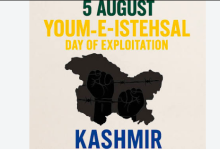
 The fundamental question that arises today is stark and unavoidable: when courts deliver verdicts, do they always deliver justice? The recent sentencing of Asiya Andrabi—awarded life imprisonment—raises serious concerns about the widening gap between law and justice. India has, over decades, increasingly weaponized legal instruments, and its natural consequence is that justice becomes the first casualty. This systemic trend has been particularly visible in Indian occupied Jammu and Kashmir since the 1990s, and more aggressively after the constitutional changes of revocation of Article 370 on 5 August 2019. In the latest development, an Additional Sessions Court in Delhi sentenced Andrabi to life imprisonment, while her associates, Nahida Nasreen and Fahmida Sofi, were handed 30-year sentences. The charges were framed under stringent provisions of the Unlawful Activities (Prevention) Act (UAPA) and sections of the Indian Penal Code, including conspiracy and sedition-related provisions.
Yet, paradoxically, the court itself acknowledged that no concrete evidence was presented linking the accused to acts of violence or harm against any individual. This contradiction strikes at the very heart of jurisprudence: how can the harshest punishments be justified in the absence of demonstrable criminal conduct? The case raises critical concerns under international law. The rights to freedom of expression, liberty, and fair trial are not merely constitutional guarantees but are enshrined in global legal frameworks such as the Universal Declaration of Human Rights (Articles 9, 10, and 19) and the International Covenant on Civil and Political Rights (ICCPR), to which India is a party. Arbitrary detention, disproportionate sentencing, and the criminalization of political expression are clear violations of these principles.
Moreover, under the Geneva Conventions, particularly in contexts of disputed territories, protections extend to civilians, including political actors, ensuring humane treatment, medical care, and protection from coercive legal measures. The prolonged detention of Kashmiri prisoners far from their homeland, often under harsh conditions, raises serious humanitarian concerns under these conventions. Aasiya Andrabi, now in her sixties, suffers from chronic arthritis and respiratory ailments. Her husband, Qasim Faktoo, has already spent over three decades in prison. Similarly, Fahmida Sofi reportedly requires spinal surgery, while Nahida Nasreen continues to endure deteriorating health. Their continued incarceration in distant prisons raises questions not only of legality but of basic human dignity.

What further complicates the matter is the court’s own acknowledgment of the defendants’ educational backgrounds and social engagement—teaching children, running welfare initiatives, and raising voices on social issues. These factors, typically considered mitigating in legal reasoning, appear to have had little bearing on the final judgment.The essence of the case lies in the criminalization of a political stance—specifically, the demand for the right to self-determination, a principle recognized under international law, including the United Nations Charter. The issue of Kashmir itself remains internationally acknowledged as disputed, with multiple UN resolutions affirming the right of its people to determine their political future.
Thus, the conviction of Andrabi and her associates appears less a matter of legal adjudication and more an act of political suppression. When courts validate such outcomes despite the absence of evidence, they risk transforming from instruments of justice into tools of state policy.
In such circumstances, the Indian judiciary must ask itself: is it upholding the law, or merely enforcing Indian power?